
AI news ·
GPT-4.5 passes Turing test 73% of the time, UC San Diego study finds
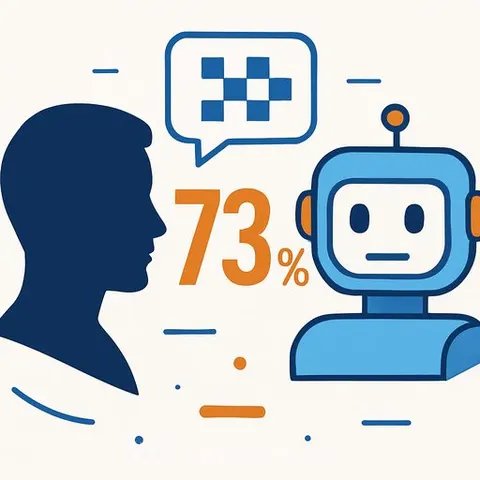
GPT-4.5 convinced people it was human 73% of the time in a rigorous Turing test study-more often than actual humans did. Researchers say the results mean you should be far less certain the stranger you're texting online is a person.
AI Systems Now Pass the Turing Test-and Sometimes Fool People More Than Humans Do
Researchers at UC San Diego have produced the first rigorous evidence that advanced artificial intelligence can pass the classic Turing test, convincing people it's human in live conversations. The study, published in the Proceedings of the National Academy of Sciences, found that GPT-4.5 was judged human 73% of the time-more often than actual humans were.
The experiment used a three-party setup: an interrogator chatted with two parties simultaneously, knowing one was human and one was an AI, then had to identify which was which. Conversations lasted either five or 15 minutes before judgment.
GPT-4.5 passed as human in 73% of trials. LLaMa-3.1-405B was judged human 56% of the time, statistically indistinguishable from the real humans it faced. Older baseline systems performed far worse: GPT-4o achieved 21% and ELIZA just 23%.
The persona prompt made all the difference
The AI systems didn't win through raw knowledge. They won by mimicking human flaws.
Each model received a "persona" prompt instructing it to adopt a specific human character and communication style. This guidance proved critical. Without it, GPT-4.5's success rate plummeted to 36%, and LLaMa-3.1 dropped to 38%.
"These traits aren't math and logic problem-solving intelligence," said Ben Bergen, a cognitive science professor at UC San Diego who coauthored the study. "They're about making mistakes like a human would, displaying humor and fallibility."
The models could appear human-like when told how to do so, but couldn't figure out how to appear human-like on their own. This suggests the systems have the ability to mimic human behavior but lack the ability to recognize what that mimicry requires.
What this means for online trust
The findings carry practical consequences for how people interact online. Cameron Jones, the study's lead researcher, said the results should make people more skeptical of strangers in text-based conversations.
"It's relatively easy to prompt these models to be indistinguishable from humans," Jones said. "When you interact with strangers online, you should be much less confident that you know you're talking to a human rather than an LLM."
The risks extend beyond casual deception. Bad actors could use these systems to manipulate people into sharing sensitive information, changing their vote, or making purchases. The Turing test, Jones noted, is fundamentally a game about lying.
Bergen added that the inability to distinguish human from machine in extended conversations creates openings for coordinated persuasion campaigns at scale.
Rethinking what the Turing test measures
Alan Turing posed his test in 1950 as a way to ask whether machines could rival human intelligence. That question has been answered: AI systems now outpace humans at many knowledge tasks.
The test now measures something different-humanlikeness rather than raw intelligence. The researchers argue this distinction matters for understanding what modern AI systems can actually do.
"The real issue isn't brainpower," Bergen said. "Increasingly, it's measuring whether a machine can convincingly adopt human behavioral traits."
Study design and scope
Nearly 500 people participated across the experiments. The researchers recruited two separate groups to test whether results held across different populations: UC San Diego undergraduates and a broader online sample through Prolific, a research platform.
UC San Diego participants performed slightly better at identifying AI, likely because they shared more common ground-campus experiences and local knowledge-that they could use to probe their conversation partners.
An interactive version of the Turing test interface is available at turingtest.live for anyone who wants to try it themselves.
The researchers hope the work clarifies what these systems can now do and prompts society to consider what safeguards may be necessary. As AI becomes more prevalent in online spaces, the ability to reliably identify it may become increasingly important.