Greece to Launch AI "Smart Entry" for ESY via 1566 Health Line
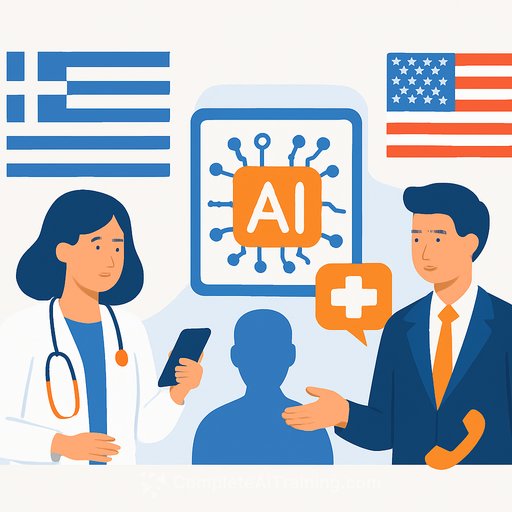
Greece's Minister of Health, Adonis Georgiadis, and U.S. Ambassador Kimberly Guilfoyle announced a cooperation to bring AI tools into the National Health System (ESY). The partnership with American company Sword Health will center on the 1566 health line and roll out a digital assistant starting Easter 2026.
The goal is straightforward: improve patient flow. Non-urgent cases-estimated by Sword Health to be up to 30% of current visits to public hospitals-will be directed to primary care instead of emergency departments. Oversight will run through the World Health Organization's office in Greece, with full awareness of Greek medical associations.
How the digital assistant will work
Callers to 1566 will first interact with a digital assistant that can provide information, make appointments, and route people to the right service based on their issue. If the assistant flags a medical concern beyond a simple query, the caller will be transferred to a doctor.
Minister Georgiadis emphasized governance and clinical judgment: "In no way will artificial intelligence replace doctors. All we hope to do with systems like this is to have better management of patient flow to hospitals." He noted the assistant is built to handle thousands of straightforward calls, improving access while preserving clinician time for serious cases.
Ambassador Guilfoyle praised the initiative: "I would like to commend your vision and bold recognition of the exceptional role that artificial intelligence can play in transforming and upgrading healthcare. American companies, such as Sword Health, are leading as pioneers and innovators… I could not be prouder that Greece recognizes the extraordinary value of American ingenuity and technological superiority."
WHO's local office will provide oversight, adding a layer of assurance for safety and quality. Learn more about the office's role here: WHO Office in Greece. Company background: Sword Health.
What healthcare leaders should prepare for by Easter 2026
- Define triage rules and escalation thresholds for the 1566 line, including clear handoffs to human agents and on-call clinicians.
- Integrate with scheduling systems to book primary care, diagnostics, and follow-ups without manual back-and-forth.
- Map referral pathways so non-urgent cases consistently land in primary care and community services, not EDs.
- Create a short patient script for call prompts so people know what to expect and what information to have ready.
- Plan training for call center staff on exception handling, documentation, and empathetic communication when the AI escalates.
- Run a privacy, security, and consent review (e.g., data minimization, retention policies, audit trails) before go-live.
- Stand up a clinical governance group with representation from medical associations to review accuracy and safety signals.
Metrics to track from day one
- Call containment rate (issues resolved without human transfer) and first-call resolution.
- Average speed to answer and call abandonment rate.
- Conversion to primary care appointments and time-to-appointment.
- Reduction in inappropriate ED visits attributed to 1566 routing.
- Clinician time saved and redeployed to higher-acuity care.
- Patient satisfaction (CSAT) and complaint rates.
- Safety outcomes: number of escalations, near-miss reviews, and corrective actions.
Risk management and guardrails
- Always-on fallback to human agents, with a "press 0" or equivalent option for edge cases and vulnerable callers.
- Language access and accessibility for older adults and people with disabilities.
- Clear documentation of routing decisions to support clinical review and learning.
- Pilot in phases with shadow monitoring, then expand by region and service line.
- Independent oversight and periodic audits in coordination with the WHO office and Greek medical associations.
The intent is practical: free staff to focus on serious emergencies and make it easier for the public to reach the right level of care. If execution matches the plan, the 1566 "smart entry" could set a new baseline for how ESY handles demand-efficient, safe, and easier for both patients and clinicians.
Your membership also unlocks: