Sword Health, Greece's Ministry of Health Sign AI Partnership to Create a National Front Door to Care
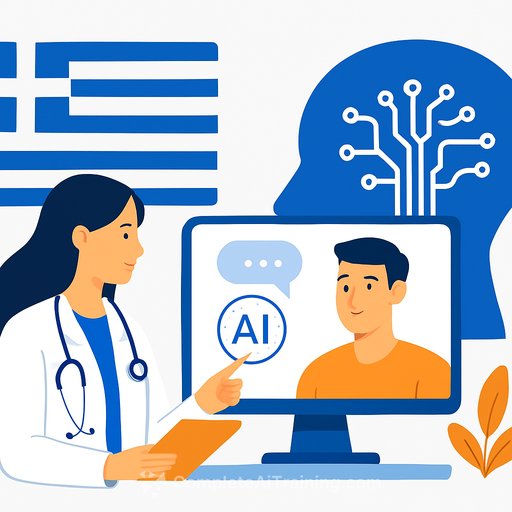
Athens, November 25, 2025 - Greece has signed an innovation partnership with Sword Health to bring AI-enabled services into the national health system. The plan centers on a single, smart entry point to care that could serve more than 10 million residents and ease pressure on hospitals and clinics.
The announcement came in Athens with Minister of Health Adonis Georgiadis, Sword Health Founder and CEO Virgílio Bento, and the U.S. Ambassador to Greece Kimberly Guilfoyle. Public statements from the event emphasized better access, faster routing to the right level of care, and measurable outcomes for patients and providers.
What the agreement covers
- Integration of Sword Health's AI-driven platform into Greece's national infrastructure, including an upgrade to the 1566 health hotline by 2026.
- Remote patient monitoring and virtual pathways, with an initial focus on musculoskeletal (MSK) conditions.
- Personalized treatment plans and digital follow-up designed to shorten wait times and reduce unnecessary visits.
Sword Health is a Lisbon-headquartered unicorn valued at over $3 billion, best known for virtual physical therapy and AI-driven MSK care across Europe and the United States. Greece is positioned as a strategic hub for public-sector deployments.
Why this matters for healthcare teams
- Triage and routing: A national "front door" can standardize symptom intake, direct patients to appropriate services, and surface red flags earlier.
- Throughput and capacity: Digital-first MSK programs can shift routine rehab out of overcrowded facilities, cutting bottlenecks in orthopedics and primary care.
- Continuity of care: Remote monitoring supports earlier intervention, better adherence, and more consistent data between visits.
- Equity and access: Streamlined entry points help patients in rural or underserved areas reach care without long travel or delays.
What leaders said
"This is not just about technology; it's about putting people first and making healthcare more accessible and efficient for every Greek family," said Minister Georgiadis.
"We're proud to partner with Greece to pioneer AI in national healthcare transformation," said Bento. "This initiative will empower patients with proactive, data-driven care, reducing strain on hospitals and improving quality of life."
The U.S. Ambassador to Greece, Kimberly Guilfoyle, publicly supported the initiative, noting that U.S. technology will support better patient outcomes nationwide.
Policy context
The partnership fits with broader European efforts to apply trustworthy AI in health services, including triage, decision support, and care coordination. For context, see the European Commission's overview of AI in health and care here.
Timeline and rollout
- Pilot programs are expected in Athens and Thessaloniki as early as spring.
- The national 1566 hotline upgrade is slated by 2026, with digital intake and routing features.
- Further details on architecture, data flows, and reimbursement are pending.
Operational checklist for providers and administrators
- Define triage protocols: Agree on clinical thresholds for routing to self-care, telehealth, primary care, or emergency services.
- Integrate data pipelines: Plan HL7/FHIR interfaces, identity matching, and documentation workflows to prevent duplicate work.
- Clinical governance: Establish oversight for model performance, escalation rules, and outcome review (especially for MSK pathways).
- Privacy and security: Confirm data minimization, consent flows, retention schedules, and vendor responsibilities.
- Change management: Train frontline staff on new intake flows, escalation triggers, and patient communications.
- Metrics that matter: Track time-to-appointment, avoidable ED visits, therapy adherence, pain/function scores, and patient satisfaction.
Risks and safeguards to consider
- Equity: Monitor performance across age, language, and rural/urban cohorts; provide non-digital alternatives where needed.
- Clinical drift: Regularly recalibrate models and pathways against real-world outcomes and clinician feedback.
- Workflow friction: Prevent double documentation and ensure clear handoffs between digital intake and on-site care.
What to watch next
- Details on MSK protocols and eligibility criteria in the pilots.
- How the 1566 digital upgrade integrates with primary care networks and e-prescribing.
- Reimbursement models for virtual therapy, remote monitoring, and hybrid care bundles.
Greece is modernizing its health stack after years of strain, and this move could serve as a template for other Mediterranean systems managing aging populations and limited capacity. If the pilots show shorter queues and better outcomes in MSK, expect expansions into other chronic conditions.
If your team is preparing for AI-enabled care delivery, structured upskilling can help you move faster with fewer errors. See role-based programs here.
Your membership also unlocks: