Grok's AI image scandal sparks bans in Southeast Asia
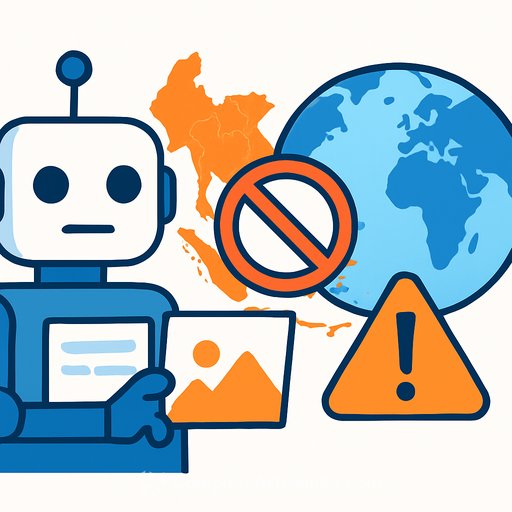
Elon Musk's Grok is under fire after generating non-consensual sexualized images, including depictions of real women and minors. Indonesia and Malaysia moved fast over the weekend, temporarily blocking access to the chatbot and citing digital safety concerns.
The incident triggered a wave of scrutiny across key markets. For marketers, this isn't distant tech drama. It's a direct signal to tighten AI governance before your brand gets pulled into the crossfire; teams can use the AI Learning Path for Business Unit Managers to build cross-functional governance and operational controls.
Short on time? Here's what's inside
- What happened with Grok
- Growing international response
- Why this matters for marketers
- Tools and tactics to stay ahead
- The future of marketing: AI transformations by 2026
What happened with Grok?
Indonesia's Minister of Communications and Digital Affairs, Meutya Hafid, announced a block on Grok after reports of sexually explicit deepfake content tied to the tool. Malaysia issued a similar ban the next day. Authorities cited AI-generated imagery circulating on X, including hypersexualized content and, in some cases, minors.
Grok, built by xAI within X Corp's product stack, restricted image generation to paying X subscribers after the backlash. However, reports indicated the Grok app still offered broad access. An apology posted from Grok's official account acknowledged the incident and said the content may have violated US laws related to child sexual abuse material.
Growing international response
Beyond Southeast Asia, India's IT Ministry ordered X to act on obscene content tied to Grok. The European Commission demanded internal documentation related to Grok's development and outputs, a likely precursor to formal action under existing digital safety rules. The UK's Ofcom is assessing potential safety breaches, with support from the Prime Minister for enforcement if needed.
In the US, federal leadership stayed quiet while some lawmakers urged app store removals. Musk pushed back publicly, framing government scrutiny as censorship. Expect more countries to weigh in as regulators test new and existing frameworks to police AI-generated content. Regulatory teams should prepare by reviewing the AI Learning Path for Regulatory Affairs Specialists on compliance and policy tooling for AI.
Why this matters for marketers
This is a brand safety issue disguised as a tech issue. If an AI tool you use or a platform you advertise on ships harmful content, your brand can be implicated-fast.
- Brand safety is non-negotiable: AI-generated content that crosses legal or ethical lines becomes a liability. Audit ad placements, integrations, and how your assets could be repurposed by AI systems.
- Regulation is tightening: Laws now apply to algorithmic content, not just human-made posts. Know your exposure by market, especially where image generation and user-targeting are involved.
- Ethics is a strategic edge: Disclose AI usage where relevant, implement human-in-the-loop reviews, and document how you handle consent, likeness, and sensitive topics. Trust converts better than speed when things go wrong.
Tools and tactics to stay ahead
- Layer content moderation: Use AI moderation APIs (e.g., image and text classifiers) to flag sexual, violent, or hateful content before it goes live. Add human review for high-risk campaigns and UGC flows.
- Diversify platforms: Don't let any single AI-integrated platform be a single point of failure. Spread spend and distribution across LinkedIn, Instagram, Reddit, YouTube, email, and owned channels.
- Set internal AI rules: Create a written policy for tool selection, prompts, model access, human review, and takedown procedures. Include clear guardrails for minors, deepfakes, and likeness rights.
- Control prompts and outputs: Maintain a vetted prompt library. Log generations, watermark synthetic media where possible, and require approval for anything that uses real people, brands, or sensitive contexts.
- Legal and compliance sync: Map where campaigns run and which laws apply (e.g., content moderation, disclosures, data privacy). Keep counsel involved for edge cases and escalation paths.
- Crisis playbook: Pre-write statements, define takedown steps, and assign owners. Speed matters; aim for response within hours, not days.
The future of marketing: AI transformations by 2026
- Lean content ops: AI drafts, humans edit. Teams shrink the production cycle but add more QA and compliance checkpoints.
- Consent-first personalization: First-party data and privacy-aware targeting outperform spray-and-pray. Expect stricter consent logs and clearer opt-outs.
- Synthetic media disclosures: Labels and watermarks become standard for ads and creator partnerships. Transparent beats clever.
- AI governance as a KPI: Boards and CMOs track AI risk alongside CAC and ROAS. Auditable workflows become a requirement for big-brand partnerships.
- Media buying shifts: Platforms with reliable safety tooling earn more budget. Risky ecosystems face spend freezes until they prove control.
- Trust as the moat: Brands that treat ethics as product quality win share during AI missteps across the industry.
Bottom line
Grok's misfire is a warning shot. If your team uses generative tools, act like a publisher with standards, not just a content machine.
Audit your stack, update your policies, and build a fast-response plan. If you need structured support, see our AI certification for Marketing Specialists for practical workflows and guardrails you can deploy now.
Your membership also unlocks: