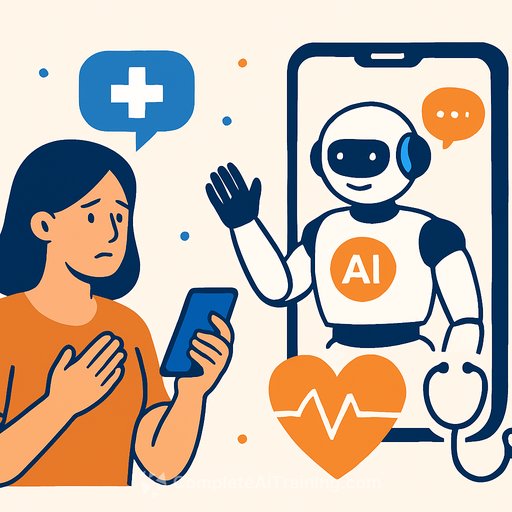
Model Context Protocols in Healthcare: Treat AI Like a Contract
FDB's Virginia Halsey puts it plainly: Model Context Protocols (MCP) act like contracts for AI. They force a high confidence threshold before the system takes action and constrain behavior so clinical use stays safe and compliant.
That mindset is what healthcare needs. Clear rules, explicit limits, and a default to safety when uncertainty spikes.
What an MCP Looks Like in Practice
- Scope of work: Define the exact task (e.g., summarize chart notes, propose order sets, draft discharge instructions). No free-form improvisation.
- Data boundaries: Specify sources the model may access (EHR fields, formulary, guidelines) and block everything else.
- Confidence gate: Require a calibrated confidence score. Below the threshold? No action. Escalate or ask for more context.
- Safe actions only: Allow low-risk outputs (highlight, suggest, compare) while routing high-impact decisions to a clinician.
- Audit and traceability: Log prompts, data touched, model version, and decisions for every interaction.
- Fail-safes: Fallback responses, rate limits, and hard stops on ambiguous or high-risk cases.
- Privacy controls: PII/PHI minimization, redaction, and role-based access aligned with policy.
Why Confidence Thresholds Matter
Confidence gates turn probabilistic output into operational discipline. They decide whether the model suggests, asks for human review, or stands down.
Set tighter thresholds for medication safety or sepsis pathways. Loosen them slightly for note summarization or routing tasks. The point: risk sets the bar.
Blueprint to Design Your MCP
- Pick one use case: Start with a narrow, high-value workflow (e.g., med rec, prior auth triage).
- Map decisions: What the AI may do, must not do, and must hand off. Keep it unambiguous.
- Define metrics: Use calibrated confidence or uncertainty proxies. Track sensitivity/specificity where relevant.
- Set gates and actions: If confidence ≥ X, suggest; if between Y-X, ask clarifying questions; if ≤ Y, escalate.
- Guardrails: Tool allowlist, controlled vocabularies, formulary constraints, and guideline references.
- Logging and review: Immutable logs, regular spot checks, and drift monitoring.
- Rollout plan: Sandbox → pilot on retrospective data → shadow mode → limited go-live with tight monitoring.
Governance and Compliance Fit
- Policy mapping: Align the contract with HIPAA, internal security policies, and clinical governance.
- Regulatory awareness: Use risk-tiered controls that support FDA/ONC expectations for safety, transparency, and oversight. See FDA guidance on AI/ML-enabled devices for context: FDA AI/ML in Medical Devices.
- Change control: Any model update, prompt change, or data-source tweak triggers re-validation.
- Human-in-the-loop: Clinician sign-off for high-impact decisions, with clear accountability.
Example: Safer Medication Reconciliation
The assistant reads the med list, discharge notes, allergies, and formulary. It flags potential duplications and interactions, but never places orders.
If the model's confidence in a suggested change is high and within scope, it drafts a note for pharmacist review. If confidence drops or data conflict, it asks a clarifying question or escalates immediately. Every step is logged.
Implementation Checklist
- One use case, one contract. Keep scope tight.
- Calibrated confidence scoring and thresholds tied to risk.
- Hard-coded allowlist of data sources and tools.
- PII/PHI minimization, redaction, and role-based access.
- Immutable logging, alerting, and periodic audits.
- Shadow testing with real but retrospective data before go-live.
- Clear escalation paths and clinician oversight.
- Post-deployment monitoring for drift, bias, and incident response.
Resources
- Technical background on the protocol: Model Context Protocol on GitHub
- Deepen your playbook for constrained AI agents in care settings: MCP
- More healthcare-focused AI guidance and training: AI for Healthcare
Bottom Line
Treat your AI like it works under a contract. Clear scope, strict confidence gates, safe defaults, and full traceability. That's how you keep clinical teams efficient-and patients safe.
Your membership also unlocks: