Three Harvard economists warn of cascading risks from war, tariffs, and AI job displacement
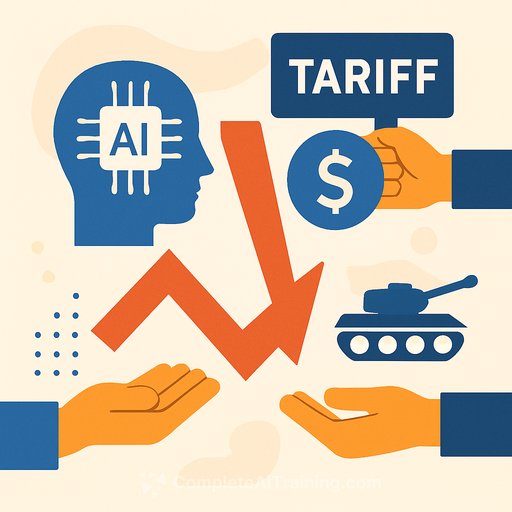
Three Harvard faculty economists said this month that artificial intelligence poses a threat to employment "of a much bigger magnitude" than the severe jobless recovery that followed the 2008 financial crisis, with potential consequences extending across government budgets and global financial stability.
Gita Gopinath, Gregory and Ania Coffey Professor of Economics, told the audience at Harvard's "From The Studio" FAS Symposium that a recession combined with AI-driven automation could trigger job losses exceeding those seen after the financial crisis. Gopinath served as first deputy managing director of the International Monetary Fund before returning to Harvard last fall.
War and tariffs create overlapping economic pressures
Carmen M. Reinhart, Minos A. Zombanakis Professor of the International Financial System at Harvard Kennedy School, said an extended U.S.-Israel war with Iran could disrupt more than oil supplies. Food, fertilizer, and shipping costs could all rise, pushing inflation higher and delaying interest rate cuts by the Federal Reserve.
Dani Rodrik, Ford Foundation Professor of International Political Economy at HKS, noted that the global economy has weathered tariffs and other trade actions since President Trump took office 14 months ago with less damage than expected. But he warned that accumulated crises could erode the confidence driving U.S. growth and global stability.
"A dissipation, dissolution of the kind of optimism that is still driving U.S. growth" could eventually occur, Rodrik said.
Dollar strength masks underlying fragility
The U.S. dollar has gained strength as global investors seek safety amid Middle East tensions. Reinhart called this a "flight to quality" - the classic pattern when uncertainty rises.
A year ago, the dollar weakened after Trump introduced tariffs, which Rodrik interpreted as "a very clear vote of no confidence in the U.S." That sentiment has reversed temporarily, but Reinhart suggested only extreme measures - such as capital controls similar to those imposed during the Great Depression - would trigger a sustained exodus from the dollar.
"I didn't think 19th-century tariffs were also on the table," Reinhart said, noting that such restrictions seemed unthinkable until recently.
Brexit offers a cautionary timeline
The panelists discussed Britain's exit from the European Union as a parallel case. Initial assessments suggested Brexit would damage the economy, but investment remained strong in the first two years.
"It looked like, wow, that was much ado about nothing," Gopinath said. "But it slowly worked through the system." Economists now estimate Brexit's long-term effects on the U.K. economy as substantial.
The pattern suggests that economic damage from tariffs and trade disruption may not appear immediately, making policy decisions harder to evaluate in real time.
AI bubble symptoms present; tax system at risk
When asked whether current AI investments-increasingly financed by credit-constitute a bubble, Reinhart said: "Are the symptoms there? The answer is yes."
Rodrik argued AI could democratize professional skills by making knowledge available to less-experienced workers. But realizing that benefit would require democratic engagement currently absent from policy discussions.
The deeper fiscal risk lies in tax revenue. Gopinath explained that most government revenue comes from taxing labor income, with capital taxed at lower rates to encourage investment. If AI shifts economic value from labor to capital, governments cannot maintain current spending on entitlements without raising capital income taxes-a politically and economically difficult shift.
"If AI leads to a transformation, where the labor share goes down by a lot more and the capital share goes up by a lot more, you can't run the kinds of programs you're running, in terms of entitlements, without having a higher capital income tax," Gopinath said. "It's just not viable."
Economists estimate that 30 percent of jobs in advanced economies like the U.S. face disruption from artificial intelligence. Understanding these risks requires familiarity with generative AI and LLM developments, and finance leaders should consider how these trends affect fiscal planning through the AI learning path for CFOs.
Your membership also unlocks: