
AI news ·
Health IT teams spend up to half their time managing AI vendors as sprawl strains resources
Health systems waste up to 50% of IT capacity managing AI vendors, with 69% of tech leaders citing integration as their top barrier to scaling solutions. Only 4% say they have enough resources to sustain the current workload.
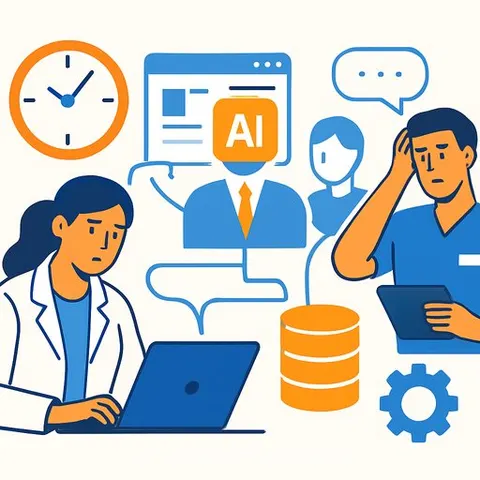
Health Systems Waste Half Their IT Time Managing AI Vendors Instead of Scaling Solutions
IT teams at medium and large health systems are spending up to 50% of their capacity managing multiple AI vendors, leaving little room to expand the tools that actually improve patient care. A 2026 survey of more than 60 senior technology leaders found that 69% cite vendor management and integration as a top obstacle to executing AI solutions.
The problem reflects a hard reality: no single vendor covers every clinical and operational need. Health systems are deploying AI across intake, diagnosis, treatment planning and follow-up - but the tools come from different companies, each adding complexity.
Why Multiple Vendors Are Necessary
Major EHR platforms like Epic cannot address every specialty's requirements. At the University of Arkansas for Medical Sciences, leadership deploys a variety of AI tools across nearly every step of the patient journey because a single platform cannot fill all gaps.
The survey shows 25% of health systems manage between four and seven AI vendors. That number reflects operational necessity, not fragmentation.
"One vendor just does not make sense," said Matthew Anderson, M.D., chief medical information officer at HonorHealth. "Epic cannot provide every single solution for every specialty in every location."
EHR systems remain foundational. Organizations typically maximize their existing EHR investment before adding external tools. But when an EHR vendor's roadmap puts needed features three years out, health systems face a choice: wait or look elsewhere.
The Resource Drain
Managing this ecosystem stretches teams thin. Survey data shows 51% of health systems spend 11% to 25% of IT bandwidth on vendor management, implementation and integration. Some allocate as much as half their IT capacity to those tasks.
Only 4% of respondents said they have adequate IT resources to sustain this level of oversight.
The work spans clinical, IT and operational teams. Vendor evaluation, implementation, data governance and ongoing oversight typically land on staff members who already have other responsibilities. At HonorHealth, Anderson described the effort as requiring "a village of street-smart, security-alert people" - but those people have other jobs.
Integration and Data Governance Lag Behind Deployment
The bigger problem emerges when tools work well in isolation but fail to fit into broader care processes. Forty-five percent of health systems report challenges scaling AI pilots into production.
Improving one workflow step while making the preceding or next step worse creates friction rather than progress. Each disconnected system adds cognitive burden on clinicians and creates new failure points.
Data governance compounds the challenge. Health systems must determine what data flows to which vendors, who owns it and where it goes. These questions remain unsolved at many organizations.
"Logging into one more thing, cutting and pasting from one thing to another - it just does not work," Anderson said.
What Health Leaders Need to Do
AI spending in healthcare nearly tripled to $1.4 billion in 2025, according to Menlo Ventures. But adding more tools without solving integration and management problems will slow progress, not accelerate it.
Health system leaders need to prioritize integration and governance before deploying additional vendors. That means establishing clear data policies, streamlining workflows across systems and ensuring IT teams have capacity for oversight - not just implementation.
Governance itself requires ongoing attention. As one leader noted, "The moment the ink has dried on your governance policy, it is outdated, and you need to start over."
For managers evaluating AI strategy, the lesson is direct: focus on making existing tools work together before expanding the vendor roster. Learn more about AI for Management and AI for Healthcare to understand how organizations are tackling these challenges.