Health Universe Builds the Infrastructure Layer for AI in Healthcare
Rock Health stopped tracking AI deals as a distinct investment category this quarter. The reason: the line between digital health companies and AI-enabled startups has blurred so completely that the distinction no longer matters.
The premise driving this consolidation is straightforward. AI could help fix healthcare's fragmented systems. Startups and investors are betting billions on it. Many will fail.
Health Universe, a San Francisco startup that raised $6 million in seed funding led by Kleiner Perkins, is taking a different approach than most. Rather than building a single AI tool for a specific problem-like ambient documentation or prior authorization-the company is constructing what CEO Dan Caron calls a "sandbox" where healthcare organizations can build and deploy multiple AI agents.
The Problem With Point Solutions
The market is crowded with narrow solutions. Abridge handles clinical documentation. Other companies focus on prior authorization or specialty prescribing. Each solves one problem well, but healthcare organizations face thousands of broken workflows.
"There's more than just prior auth," Caron said. "There are thousands and thousands of workflows in healthcare that are humans marching to a fax machine or doing data entry into some old, rigid system."
Point solutions don't address the underlying issue: legacy systems and fragmented infrastructure. A new AI tool bolted onto outdated technology won't fix the problem.
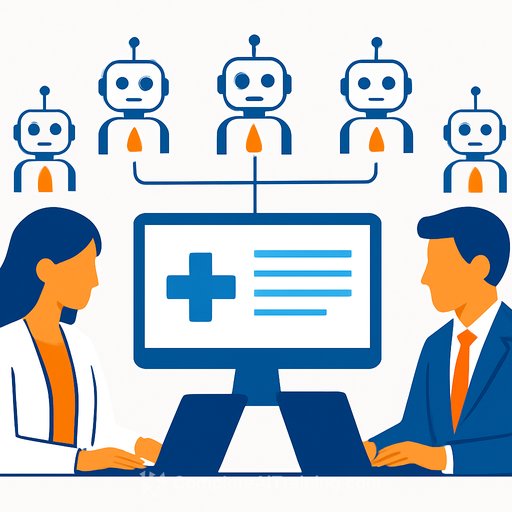
Health Universe positions itself as a single integration point. Once connected, organizations can develop agents internally, license them from vendors, or build them with Health Universe. The company doesn't claim to have the best AI solution. It claims to be flexible enough to work with whatever models and tools emerge next.
Customers-mostly academic medical centers, individual researchers, clinical laboratories, payers, and small providers-return asking for additional agents once they see the flexibility. They skip buying separate point solutions and build new agents on Health Universe instead.
How AI Agents Verify Their Own Work
A legitimate concern with AI in healthcare: how do clinicians know the system reached the right conclusion? Neural networks aren't transparent by design.
Health Universe returns sources back to original medical records so clinicians can verify the reasoning. The company also uses techniques like "LLM-as-a-Judge"-automated systems that flag high-risk outputs for human review.
Internal studies comparing AI summaries to those written by human reviewers found something unexpected. AI summaries often contained important clinical details that experienced humans missed.
This doesn't mean AI is infallible. Humans have biases too. The goal is coexistence, not replacement. Clinicians make final decisions; AI handles the preparatory work.
Speed at Scale: The Duke Clinical Trial Example
Health Universe recently partnered with Duke's Division of Clinical Research Institute to build agents that accelerate trial setup. A principal investigator writes a short synopsis. An agent generates a full clinical trial protocol by reviewing existing trials, applying relevant schemas, and ensuring internal consistency.
From that protocol, agents generate downstream documentation: electronic case report forms, patient-reported outcome forms, and regulatory markup for institutional review boards. A human reviews and approves each step.
The result: Duke established a new clinical trial in 7.5 days. The standard timeline is six to nine months.
The De-skilling Risk
Caron acknowledges a real concern: as AI handles more cognitive work, clinicians may lose the skills that come from hands-on experience and judgment.
One potential safeguard is building active learning into the interface. Rather than simply presenting a recommendation, the system could pose multiple-choice questions that train the clinician. AI could also flag when a clinician's prescribing patterns lag behind new treatment guidelines.
The underlying principle: those designing AI systems must consider whether the tools make humans less capable or more informed.
The Competitive Landscape
Nvidia is also building infrastructure for AI in healthcare, focusing on federated data-a method for training models across institutions without sharing raw data. Health Universe operates at the application layer, where institutions bring their own data and EHRs into shared workspaces.
Health Universe includes user experience, authentication, authorization, and a marketplace where organizations can discover and share AI applications. A computer vision model that detects posture and scoliosis risk is one example.
The company is developing an agent marketplace where organizations can exchange information through AI agents rather than faxes. A patient's personal agent could summarize health data and send it to a clinician, whose agent could then propose interventions ranked by relevance to that patient's medical history.
OpenAI and Anthropic lead in foundation models, Caron said, but they're unlikely to build the security, compliance, and regulatory infrastructure required to connect patients and providers safely.
For healthcare organizations evaluating AI infrastructure, the question isn't which single tool to adopt. It's which platform allows them to experiment with multiple agents as models and priorities evolve.
Your membership also unlocks: