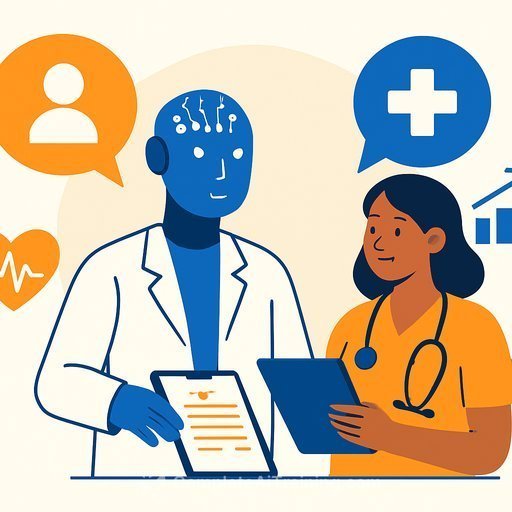
AI's Real Test Is Healthcare
AI isn't struggling with code or contracts. Its hardest test is your clinic: layers of regulation, life-or-death stakes, complex biology, and care that's built on trust.
Nearly a decade ago, Geoffrey Hinton predicted AI would outperform radiologists within five years and make training new ones unnecessary. Today, there are more radiologists than ever, and of the 950 AI/ML tools with FDA authorization from 1995-2024, 723 are in radiology. Capacity expanded. Clinicians didn't disappear.
Hinton reframed the miss as economics, not technology. Healthcare demand is elastic. If clinicians can do ten times more, the system will deliver ten times more care. AI won't shrink the workforce; it will expose the backlog that's always been there.
Where AI Outperforms-and Where It Fails
In several studies, standalone AI beat physicians who had access to AI as a tool. One culprit is automation neglect: clinicians stick with an initial impression and underweight the model's alternative. Another is simple inexperience-most teams haven't learned how to collaborate with these systems.
Not all evidence favors the machine. In a randomized trial in Nature Medicine on suspected genetic cardiomyopathies, general cardiologists assisted by AI produced assessments that specialists preferred, with fewer clinically significant errors. Still, 6.5% of AI responses contained clinically significant hallucinations. When questioned-"are you sure the ventricle is thickened?"-the model often corrected itself.
There are also red flags. A recent Nature Medicine paper reported severe triage errors from a state-of-the-art model, telling some high-risk patients to stay home. The lesson is blunt: for some tasks, AI alone is best; for others, the team wins; and in a few, the tech is dangerously unreliable. The job is to know when.
Practical guardrails for clinical use
- Risk-tier your use cases. Start with low-risk tasks (measurement, workflow, summarization) before high-risk decisions (triage, diagnosis, treatment).
- Validate in shadow mode on local data. Report sensitivity, specificity, AUC, NPV/PPV, calibration, and subgroup performance before go-live.
- Make uncertainty visible. Surface confidence scores and require a "challenge-response" step (e.g., prompt the clinician to question key findings).
- Define override and escalation rules. Log disagreements, rationale, and outcomes. Review patterns weekly.
- Monitor drift and incidents. Set thresholds for auto-disable and a clear revalidation path after updates.
- Train against failure modes. Cover automation bias, automation neglect, anchoring, and over-reliance on "AI says."
- Address consent and transparency. Tell patients when and how AI is used, in plain language.
- Secure PHI. Complete vendor security reviews (e.g., BAA, data retention, access controls) and document MDS2 where applicable.
- Stay within indications. Know the model's FDA-cleared use, and document any off-label use with added supervision.
- Check equity. Track performance by age, sex, race/ethnicity, language, and site. Intervene when gaps appear.
From Reactive Care to Early Signals
The bigger shift isn't accuracy; it's timing. Neurodegeneration, cancer, and cardiovascular disease incubate for 15-20 years. With wearables, sleep sensors, and multi-omics, we can move upstream-weeks, months, or years earlier.
Half a billion people already generate continuous vitals from wrist devices. Research shows more than a hundred conditions can be predicted from a single night of sleep sensor data. "Organ clocks," built from thousands of blood proteins, estimate the biological age of specific organ systems. The missing piece is a clinical map of the immune system-the immunome-which may knit together cancer, neurodegeneration, and heart disease risk.
The opportunity isn't one breakthrough app. It's infrastructure: pipelines for sleep and wearable data, proteomic testing at scale, and AI that quietly flags early drift from baseline long before symptoms show up.
How to prepare your organization
- Stand up a longitudinal data layer. Stream wearable vitals, labs, imaging metadata, and meds into a governed registry.
- Standardize consent for continuous monitoring and research use with clear opt-out paths.
- Pilot early-warning programs with closed-loop workflows (alert → outreach → appointment → follow-up).
- Add proteomic and other advanced biomarker collection to select clinics; link to outcomes for continuous learning.
- Define upstream metrics: earlier-stage detection, avoided admissions, turnaround time, waitlist reduction, and patient-reported outcomes.
- Create a cross-functional review board (clinical, quality, IT, legal) to approve models and monitor performance.
Regulation, Liability, and the Human Limit
Liability is asymmetric. If a clinician skips AI and harm occurs, cases are rare. If a clinician uses AI and harm follows, lawsuits come fast. That slows adoption, even as the status quo carries heavy harm: an estimated 12 million diagnostic errors annually in the U.S., leading to about 800,000 people with disability or death.
Empathy is the other boundary. Some argue advanced systems can express genuine empathy; others say they only channel its surface form. Patients still want to look a person in the eye and feel seen. Keep the human at the bedside. Let the machine extend attention, not replace it.
90-day action plan
- Pick 2-3 high-yield, low-risk use cases: radiology worklist triage, echo measurements, note drafting with structured outputs.
- Run a 4-week shadow study. Predefine metrics and decision thresholds; compare against current performance.
- Implement a "question-the-model" step in the UI for critical findings. Make it fast and mandatory.
- Publish an AI use policy: indications, documentation, override rules, incident reporting, and patient communication.
- Stand up a weekly model performance review with corrective actions and a rollback plan.
- Educate teams with short, role-based sessions. See AI for Healthcare for practical training paths.
- Choose vendors with FDA authorization where applicable and align with FDA's AI/ML device listings and GMLP guiding principles.
The takeaway
AI won't replace clinicians. It will surface how much care we've been leaving undone and shift our focus earlier, where it matters most. Build the guardrails, measure honestly, and let the tech extend your reach-so your team can spend more time on the moments only humans can do well.
Your membership also unlocks: