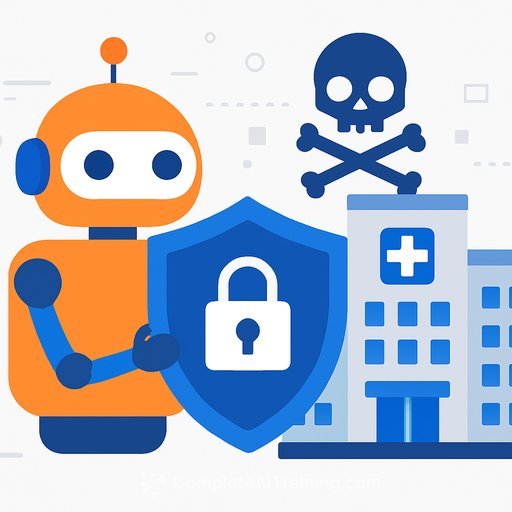
Why Healthcare Needs AI-Powered Cyber Resilience
Cyber attacks don't just hit budgets and headlines in healthcare. They halt diagnostics, delay surgeries, and put patient outcomes at risk. The recent NHS incidents that forced major London hospitals to cancel operations made that painfully clear. For resources on clinical AI applications and sector-specific guidance, see AI for Healthcare.
For providers, this shifts cybersecurity from a back-office concern to a clinical safety issue. Cyber resilience isn't a strategy on paper. It's a requirement to keep care moving.
Why healthcare is such a tempting target
Healthcare systems hold high-value data: personally identifiable information and protected health information. That data fuels extortion and fraud. And because downtime directly affects patient care, ransomware crews bet that providers will pay to restore services fast.
The environment is also complex. Interconnected medical devices (IoMT) often run legacy or unpatched software. Shared workstations, distributed networks, and strained staff increase the odds that a targeted phishing email works. Perimeter-only defenses miss too much in this reality.
Why complete visibility matters
You can't secure what you can't see. Healthcare teams need consistent, real-time insight into activity across networks, devices, users, and applications. That starts with continuous collection of network traffic and other telemetry to understand what "normal" looks like for your environment.
With a clear baseline, subtle anomalies stand out sooner-unusual east-west traffic, a jump in failed logins, a device reaching destinations it never touches. This makes detection faster and investigations cleaner. Like vitals and imaging for a patient, reliable visibility drives better decisions.
From insight to action
Early signal detection shrinks attacker dwell time and limits damage. End-to-end views help teams trace activity, confirm scope, and act with confidence. That means blocking exfiltration attempts, isolating compromised devices, and cutting off lateral movement before it takes root.
The result: fewer canceled clinics, fewer delayed treatments, fewer sleepless nights for clinical and IT staff.
What AI adds-and what it needs
Attackers are already using AI to move faster and hide better. Defenders can meet that speed with AI for IT & Development-applying machine learning to consistent, high-fidelity data to detect patterns humans miss and automate containment in real time.
But quality beats quantity. AI is only as good as the telemetry you feed it. Context matters. "Garbage In, Garbage Out" still applies. Prioritize sources that provide clean, continuous, and correlated data across your environment so AI can spot what actually matters and cut noise for your team.
Practical steps for healthcare leaders
- Map what keeps care running: Identify critical clinical services, applications (EHR, PACS, LIS), and supporting systems. Rank by business and patient impact.
- Inventory and segment IoMT: Discover every device, classify by risk, and place high-risk or legacy systems into controlled network zones with least-privilege access.
- Establish continuous visibility: Collect network traffic, endpoint, identity, and cloud telemetry. Baseline normal behavior per site, unit, and device type.
- Adopt network-centric threat detection: Use NDR to see lateral movement, command-and-control, and data exfiltration-even when endpoints miss it.
- Tighten identity controls: Enforce MFA, conditional access, and privileged access management. Monitor for session hijacking and abnormal privilege use.
- Stress-test incident response: Build playbooks for ransomware, data theft, and clinical downtime. Run tabletop exercises with IT, clinical leadership, and comms.
- Protect backups like gold: Maintain immutable, offline backups. Test restores regularly and measure recovery time against clinical tolerances.
- Harden email and reduce social risk: Deploy modern email security and security awareness focused on real phishing lures seen in healthcare.
- Measure what matters: Track MTTD, MTTR, dwell time, and mean time to contain. Tie metrics to patient service impact to guide investment.
- 24/7 monitoring: Ensure round-the-clock coverage via in-house, co-managed, or MSSP models. After-hours gaps are attacker opportunities.
- Vendor and data-flow oversight: Assess third parties with access to PHI. Require segmentation, logging, and breach notification standards.
- Clinically grounded downtime plans: Keep paper procedures, offline orders, and read-only EHR modes ready. Train frontline staff annually.
Guidance worth bookmarking
For a solid foundation on sector-specific practices, review HHS 405(d) Health Industry Cybersecurity Practices. It's practical, risk-based, and widely adopted across U.S. healthcare.
- HHS 405(d) Health Industry Cybersecurity Practices
- Coverage of NHS cyber incidents affecting London hospitals
Where AI fits in your roadmap
Start with data quality. Ensure your observability stack collects consistent, curated telemetry across on-prem, cloud, and clinical networks. Add AI that can analyze this stream in context, detect behavioral anomalies, and automate first-line actions-quarantine, block, or step-up authentication.
Then close the loop. Feed analyst feedback into the models, tune detections to reduce false positives, and link outcomes to patient-centric KPIs like canceled appointments avoided or turnaround time preserved in labs and imaging.
Bottom line
In healthcare, protecting digital infrastructure is protecting patients. The quickest way to strengthen your position is to get visibility right, reduce dwell time, and let AI act on high-quality data.
Focus on signal over noise, moves over slogans, and measurable outcomes over checklists. Your patients will feel the difference-often without ever knowing why their care stayed on track.
If you're building internal skills for AI in operations and security, here's a curated directory to help your teams ramp up fast: AI for Operations.
Your membership also unlocks: