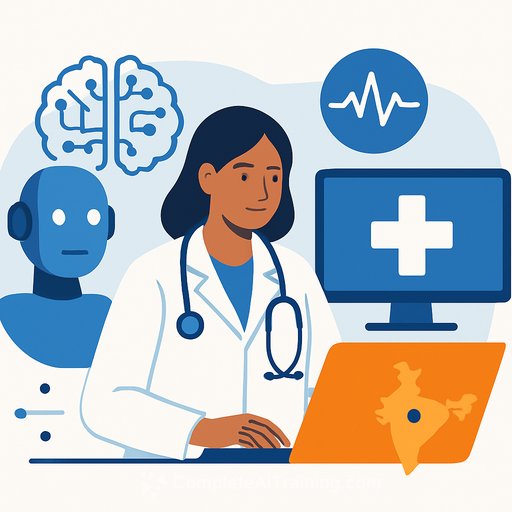
Can AI Make Healthcare Smarter, Faster, and More Accessible?
AI in healthcare isn't new. The first "medical consultant" powered by algorithms appeared in 1971, using symptom inputs to suggest diagnoses. What's new is our reach, compute, and connectivity-now good enough to move AI from labs into daily clinical work.
But progress hasn't been a straight line. Early big swings taught us what it takes to make AI useful at the bedside and in the field.
What We Learned From Early Big Bets
About 15 years ago, a major push tried to apply AI to oncology using knowledge from top U.S. cancer centers. The theory was sound: encode best practices from millions of cases and share them everywhere.
The gap showed up in the data. Models trained on U.S. cohorts didn't always translate to Indian patients, local protocols, or available regimens. Tech also wasn't as capable, or as easy to fit into clinical workflows. That wave faded, but the lesson stuck: local data and tight integration matter.
What Changed: Tech, Behavior, and Bandwidth
Telemedicine went from "maybe later" to mainstream during COVID. Video has become normal-even in remote districts with 5G coverage. That shift unlocked new care pathways.
Imaging AI now flags findings on chest X-rays, CTs, mammograms, and fundus photos with strong accuracy in specific tasks. Paired with tele-radiology or tele-ophthalmology, that can shorten queues and route high-risk cases to the front.
Proof Points You Can Use
- Outbreak intelligence: Since 2022, an AI system at India's National Centre for Disease Control has scanned web signals for unusual health events, helping issue 5,000+ alerts and cutting manual workload by 98%. Event-based surveillance like this complements IDSP workflows. See IDSP
- Preventive screening at pace: Leveraging deep imaging expertise plus AI, some centers now deliver full-body screening in under two hours, with a calmer patient experience. The point isn't bells and whistles-it's throughput, standardization, and early catch. Always check validation on local cohorts.
- Quiet wins: E-pharmacy fulfillment, appointment routing, coding, claims adjudication, and supply chain forecasting-AI is already behind the scenes shaving hours and errors.
Where AI Helps Today (Practical Targets)
- Radiology and triage: Prioritize worklists, detect critical findings, reduce turnaround time.
- Pathology and lab: Image analysis for slides and smears; QC on analyzers.
- Ophthalmology and dermatology: Store-and-forward screening in primary care.
- Infectious disease: Syndromic and event-based surveillance to spot clusters early.
- Operations: No-show prediction, smart scheduling, RCM, and denial prevention.
- Patient services: AI assistants for FAQs, discharge instructions, and refill flows.
Adoption Checklist for Healthcare Leaders
- Define the problem: Pick a narrow, high-friction use case (e.g., CXR triage, denials).
- Local validation: Demand performance on your data and population; track equity across subgroups.
- Workflow fit: Map current steps; decide where AI sits; measure clicks saved and minutes gained.
- Data governance: PHI minimization, retention limits, audit trails, and clear data-sharing terms.
- Clinical safety: Human-in-the-loop, fail-safes, escalation rules, and clear labeling of AI outputs.
- Regulatory and ethics: Follow guidance and approvals where applicable. WHO's guidance on AI for health is a good reference.
- Security: Vendor security posture, model supply chain risk, and red-teaming for prompt and data leakage.
- Vendor transparency: Request model cards, data sources, update cadence, and monitoring plans.
- Change management: Train end users, set feedback loops, and appoint a clinical champion.
- ROI and quality: Define metrics upfront-turnaround time, recall rate, LOS, patient NPS, or cost per case.
A 90-Day Pilot Plan
- Weeks 1-2: Baseline metrics, workflow mapping, data-sharing agreements, and risk assessment.
- Weeks 3-6: Shadow mode validation on local data; compare against current standard.
- Weeks 7-10: Limited rollout with human oversight; daily huddles for issues and drift.
- Weeks 11-13: Evaluate metrics; decide expand, fix, or stop. Document SOPs and training.
Guardrails That Build Trust
- No autonomous diagnosis or treatment decisions without clinician oversight.
- Clear patient communication when AI is used; opt-outs where required.
- Equity checks: Performance across age, sex, and socioeconomic groups.
- Post-deployment monitoring: Drift detection, incident reporting, and version control.
Case Notes: Why Local Context Wins
Models travel poorly without adaptation. Treatment protocols, formulary access, comorbidities, and imaging equipment vary by site. Retraining or calibrating on local data consistently improves results and clinician trust.
This is why a screening center that knows its community, its devices, and its constraints can outperform a generic model trained far away-even if both use similar algorithms.
Headlines Worth Your Attention
- Only 1 in 10 Indian CXOs say current IT stacks meet their AI needs.
- Central banks are using AI for low-risk tasks while watching cybersecurity exposure.
- Chinese tech majors shift AI training offshore to access restricted hardware.
- A historically quiet player in AI is now moving faster at global scale.
- Short "AI micro degrees" are being used to upskill tech talent in India.
- China flags bubble risk in humanoid robotics.
- Benchmark chatter: Some models claim higher Mensa-style scores than well-known peers.
- AI-powered shopping assistants are lining up against search incumbents.
The Bottom Line
AI already saves time, reduces error, and expands reach across care pathways. The winners will pair strong models with local data, tight workflows, and rigorous governance. Keep it practical, measurable, and patient-centered-and scale what works.
Upskill Your Team
If you're planning rollouts or need structured learning paths for clinical, ops, or IT staff, see curated options by role here: AI courses by job.
Your membership also unlocks: