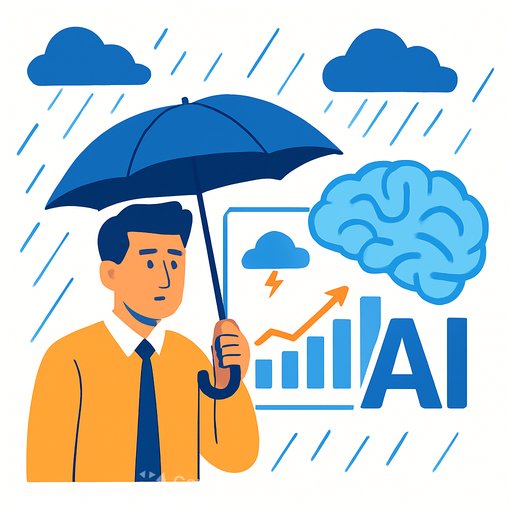
Can AI Models Be Trusted to Predict Heavy Rainfall?
Trust isn't a feeling. It's earned with repeatable skill, clear uncertainty, and proven impact on decisions. Heavy rainfall makes that hard: events are rare, local, and driven by messy physics and data gaps.
If you work in science or research, here's a practical framework to judge whether an AI rainfall model deserves a place in your toolbox or your operations.
What "trust" actually means here
- Discrimination: Can the model separate heavy-rain days from quiet days?
- Calibration: Do predicted probabilities match observed frequencies across thresholds?
- Spatial and temporal coherence: Are rain bands, intensities, and timings physically plausible?
- Lead-time aware skill: Does performance degrade gracefully from 0-6 h (nowcasting) to 1-5 days?
- Uncertainty you can act on: Are ensembles and quantiles reliable enough for cost-loss decisions?
- Stability: Does skill hold across seasons, regimes, and new regions without silent failure?
Data makes or breaks the model
Most "AI can't be trusted" problems are data problems. Fix them before blaming the model.
- Targets: Prefer gauge-radar merged products with QC. Understand gauge undercatch, radar beam blockage, and bright-band issues.
- Predictors: Blend radar nowcasts, satellite, reanalysis, and NWP fields; align them on a consistent grid and time base.
- Event definition: Be explicit (e.g., 10/25/50 mm in 1 h or 24 h). Align thresholds to user impact.
- Leakage control: No peeking into the future via smoothing, reanalysis windows, or post-processed NWP fields.
- Spatiotemporal splits: Use blocked cross-validation by time and region to avoid optimistic skill.
- Class imbalance: Handle extremes with focal/weighted losses, stratified sampling, and evaluation on tail events.
NOAA MRMS is a solid reference dataset for many regions; know its limitations before you train on it.
Baselines before breakthroughs
Never assess trust without strong baselines. At minimum compare against:
- Persistence and climatology
- Optical-flow radar nowcasting (0-3 h)
- Operational NWP and its post-processing (e.g., ensemble quantiles)
Model families that tend to work
- Nowcasting (minutes-hours): ConvLSTM/Temporal U-Net/Transformer variants on radar-satellite stacks, often with optical-flow hints.
- Short to medium range: ML post-processing of NWP (EMOS, quantile regression forests/GBMs, isotonic calibration, distributional deep nets).
- Spatial structure: U-Nets and diffusion-style models for precipitation fields; graph or attention models for orography and rivers.
- Hybrid physics-ML: Physical constraints or bias-correction layers to avoid impossible totals or spurious convection.
Metrics that actually reflect risk
- For rare events: Precision-Recall curves and Average Precision; Critical Success Index (CSI) or Equitable Threat Score (ETS).
- Probabilistic skill: Brier Score with reliability-resolution decomposition; reliability diagrams; Expected Calibration Error.
- Quantiles: Pinball loss and CRPS for ensemble/quantile forecasts.
- Spatial verification: Fractions Skill Score and neighborhood methods to avoid unfair pixel penalties.
- Tail focus: Report skill by threshold bins (e.g., ≥P90, ≥P99, ≥P99.9) and by lead time.
For deeper rigor, see the WMO guidelines on forecast verification.
Uncertainty you can use
- Prefer ensembles or distributional outputs over point estimates.
- Calibrate with isotonic regression, temperature scaling, or EMOS; verify with CRPS and reliability.
- Map probabilities to actions using a cost-loss framework; publish recommended thresholds.
Stress tests before deployment
- Regime shifts: Heatwaves, blocking highs, land-sea contrasts, monsoon onset/retreat.
- Domain transfer: Move across terrain, climate zones, and radar networks.
- Observation quirks: Gauge outages, radar dropouts, wet-radome artifacts.
- Tail holdouts: Evaluate strictly on unseen extremes and compound events (e.g., saturated soils + intense bursts).
- Temporal drift: Year-by-year skill and trend; watch for nonstationarity under warming.
Operational checklist
- Latency budget and fallbacks to NWP or persistence.
- Real-time monitoring: reliability, sharpness, and hit/miss rates by threshold and region.
- Drift detection and scheduled recalibration; versioned datasets and models.
- Clear model cards: training data, known failure modes, intended use, and off-label warnings.
- Human-in-the-loop review for high-impact alerts and unexpected spatial patterns.
Known pitfalls
- ROC-AUC inflation: Looks great on imbalanced data while missing the top 1% events that matter.
- Data leakage: Reanalysis windows, smoothed targets, or misaligned timestamps.
- Over-smoothing: Pretty maps, muted extremes; check max-intensity distributions.
- One-size thresholds: A 25 mm/24 h alert means different things in mountains vs. coasts.
Open research questions
- Physics-informed losses that respect moist processes and conserve mass/energy where relevant.
- Generalization under climate change; domain adaptation without erasing extremes.
- Coupling precipitation forecasts with hydrological models for flood risk, end to end.
- Interpretability that goes beyond saliency: causal tests, counterfactuals, and feature attributions tied to dynamics.
A simple, practical plan
- Define decisions and thresholds first (who uses what, by when).
- Assemble data with rigorous QC; document gaps and biases.
- Lock baselines; add one model family at a time.
- Evaluate by lead time and threshold with reliability front and center.
- Stress test; publish failure modes; deploy with guardrails and monitoring.
Further learning
If you're building or evaluating these systems in your lab or team, you may find these useful:
- Data Analysis - model validation, probabilistic metrics, and imbalanced-event methods.
- AI for Science & Research - applying and stress-testing AI in scientific workflows.
Bottom line: You can trust an AI rainfall model when it proves calibrated, discriminative, stable across regimes, and decision-useful. Until then, it's a research artifact - treat it like one.
Your membership also unlocks: