AI Helps Scientists See Molecules Hidden in Cell Images
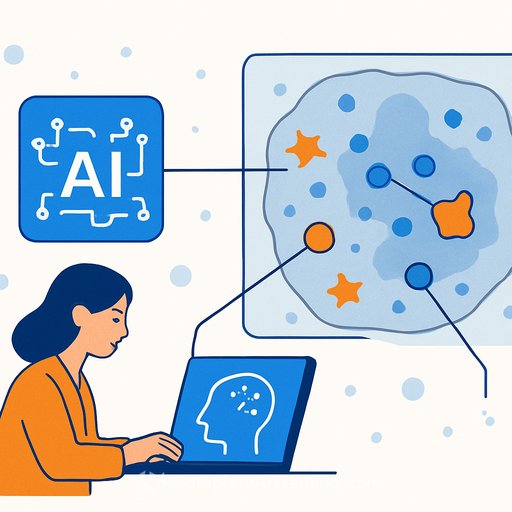
Cryo-electron tomography produces 3D images of cells at nanometer resolution, but finding individual molecules within those images remains tedious and error-prone. Researchers at HHMI are using AI to change that.
Eric Gouaux at Oregon Health and Science University and Michael Rosen at UT Southwestern Medical Center lead a project to train AI models that recognize gold nanoparticles attached to molecules of interest. The particles serve as molecular markers, but spotting them in noisy images demands hours of manual work.
The approach matters because understanding where molecules sit and how they connect reveals how larger cellular structures function. Rosen's team studies densely packed DNA in cell nuclei to understand gene expression. Gouaux's group examines synapses - the junctions where neurons communicate - to understand signal transmission.
Training Models on Real Data
The team plans to develop AI models that recognize gold nanoparticles of different shapes and brightnesses faster and more accurately than human analysis allows. The researchers will also test multiple types of labels simultaneously, potentially revealing more molecular details from a single image.
Rosen's collaborator Rosana Collepardo-Guevara at the University of Cambridge is creating molecular simulations of chromatin. Training AI on both real biochemical data and simulations should improve predictions about molecular location and how mutations or aging affect structure.
The work is part of AI@HHMI, a $500 million initiative funding AI-driven scientific projects across the institute.
Wider Application Ahead
The researchers aim to build tools that biologists worldwide can use without specialized expertise in either AI or cryo-electron tomography. Elizabeth Villa, collaborating on the project, said the method could appeal to scientists who currently avoid the technique because it demands too much manual interpretation.
Rosen said a generalizable AI approach that identifies multiple labeled molecules and determines their structures would transform research across many fields. Gouaux noted that collaborating with AI experts, cryo-ET specialists, and annotation teams at HHMI's Janelia Research Campus made the project feasible.
Learn more about AI for Science & Research or explore AI Research Courses to develop skills in machine learning for scientific applications.
Your membership also unlocks: