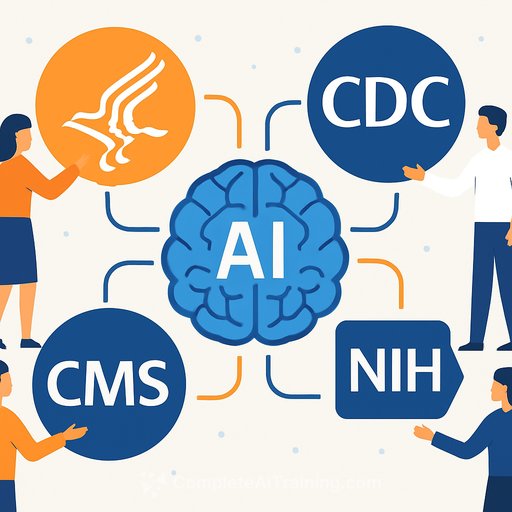
HHS Launches 'OneHHS' AI Strategy to Integrate AI Across Federal Health Agencies
The U.S. Department of Health and Human Services introduced a unified AI strategy to bring AI into daily operations across its major divisions. The move fulfills direction from the Trump Administration to expand the use of advanced technologies across federal operations.
Branded as "OneHHS," the model centers on internal efficiency, scientific rigor, and better public health workflows. It brings every HHS agency under one framework to cut duplication, improve data flow, and reduce fragmentation.
Deputy Secretary Jim O'Neill characterized AI as a disruptive step for healthcare delivery and federal operations, and signaled a faster path to adoption across mission-critical functions.
Unified Framework Across CDC, CMS, FDA, and NIH
For the first time, HHS is bringing its leading agencies onto a single AI infrastructure and governance model. The initial scope includes the CDC, CMS, FDA, and NIH.
By consolidating infrastructure and data workflows, the department expects fewer operational silos and stronger cybersecurity across high-risk systems.
Five Pillars to Guide AI Deployment
- Governance and risk management: Clear guardrails to reinforce public trust and accountable use.
- Infrastructure and platform design: Shared platforms built around user needs and repeatable deployment patterns.
- Workforce development and burden reduction: Training, streamlined processes, and tools that cut manual work.
- Health research reproducibility: Validated methods and auditability for scientific outputs.
- Modernized care and public health delivery: Applied AI for better outcomes in operations and service delivery.
The strategy is led by Acting Chief Artificial Intelligence Officer Clark Minor, building on OMB direction and the Administration's AI Action Plan.
What This Means for Operations Teams
- Single playbook: Expect common standards for data access, model approvals, monitoring, and incident response across agencies.
- Shared platforms: Central hosting, model registries, and tooling to shorten time-to-deploy and reduce one-off builds.
- Security by default: Baselines for privacy, cybersecurity, and responsible-use checks embedded in workflows.
- Cleaner handoffs: Standardized interfaces across divisions (policy, clinical, research, finance) to reduce rework.
- Measurable value: Emphasis on throughput, error reduction, and cycle-time metrics to prove impact.
Phase One: Federal Use First, Industry Later
The first phase focuses on federal use cases. HHS says the framework will inform future engagement with private-sector technology developers, setting expectations for secure, scalable solutions in public health and healthcare administration.
Operations Checklist to Get Ahead
- Map your highest-friction workflows (claims review, contact centers, surveillance intake, compliance reporting) and flag steps fit for AI assistance.
- Tighten data quality and access controls; document sources, owners, and retention policies.
- Stand up lightweight model governance: use-case intake, risk scoring, human-in-the-loop criteria, and performance monitoring.
- Run small pilots with clear success metrics (e.g., turnaround time, accuracy, unit cost), then scale what works.
- Develop a skills plan for analysts, clinicians, and program staff; pair training with actual use cases.
- Coordinate with security early on threat modeling, privacy impact assessments, and vendor due diligence.
If you're building team capability, see role-based options here: AI courses by job.
Standards and Guidance to Watch
- OMB M-24-10: Advancing Governance, Innovation, and Risk Management for Agency Use of AI
- NIST AI Risk Management Framework
The Bottom Line
OneHHS gives operations leaders a clear mandate: standardize how AI is built, approved, secured, and measured. Expect shared platforms, fewer silos, and stronger controls-paired with pressure to deliver concrete performance gains.
Start small, measure hard outcomes, and align your team's skills and controls with the five pillars. That's how you'll plug into the OneHHS model without slowing down delivery.
Your membership also unlocks: