Hong Kong's First AI Art Festival Opens: Will AI Replace Artists?
Published: 19:53, December 19, 2025 | Updated: 21:10, December 19, 2025
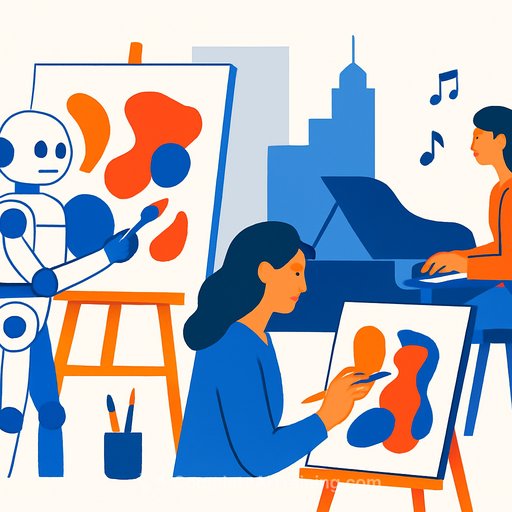
AI ink wash paintings and other examples of Generative Art. Robots practicing calligraphy. A robot playing the piano while a crowd records it like a headlining act. The inaugural Hong Kong AI Art Festival turned speculation into something you can see, touch, and question.
Hosted at the Hong Kong Convention and Exhibition Centre and organized by Bauhinia Culture Group, the event brought together 30 artists and more than 30 robotics companies from around the world. The theme - "Envisioning the Future: Reality and Boundlessness" - set a clear intention: push art and tech to meet, then see what sticks. It also doubled as a statement of Hong Kong's ambitions in innovation and cultural exchange.
What AI can (and can't) do on its own
One installation, "The Dream of Robots," let a sleeping robot "perceive" viewers one-on-one. It captured each participant's external features and, with a large language model, generated particle-based visuals and text - like you briefly appeared inside the robot's dream.
Here's the catch the piece quietly underlines: AI creates inside the frame you hand it. As creator Liu Jiayu put it, AI can produce within defined contexts, but it doesn't craft the context itself. That framing - the intent, the meaning, the why - is still the hard part, and it's still human.
Will AI replace artists?
Market signals say AI art is already part of the conversation. In March, an AI-generated animation by Refik Anadol sold for $277,000, which fueled plenty of debate. But Turing Award laureate John Edward Hopcroft offered a counterweight from Research: even if an AI-made image looks indistinguishable from a human's, it won't feel the same because the point isn't the pixels - it's the intent they carry.
If you make art, that should land as good news. Craft, taste, and context remain the differentiators.
How creatives are using AI right now
Artist Wang Xiaohui showcased an AI-driven video series featuring 100 futuristic career women. Before, stitching visuals together took ages. Now, AI generates dynamic sequences directly.
Her comparison is blunt: building a century of past archetypes took two years; projecting the next 100 took under two months with AI. The takeaway isn't "let AI do it all" - it's to let the tech handle volume so you can focus on ideas that can't be replaced.
Cultural regeneration, with care
A Hangzhou-based team screened a VR film built around stories from three historical periods connected to grottoes. AI helped restore image quality so viewers could step into the scenes with a headset. As one creator, surnamed Qian, said: AI is a tool; narrative is the spine.
Practical takeaways for working creatives
- Define the frame first. Write a short creative brief (theme, constraint, emotion). Then let AI riff inside it.
- Use AI for volume work: mood boards, style variations, storyboard passes, motion tests, cleanup, and restoration.
- Keep authorship visible. Annotate process, share iterations, and document decisions - that's your value, not just the file you export.
- Prototype fast, then curate hard. Generate 100 options, shortlist 5, refine 1. Curation is the art.
- Measure the lift. Track time saved per task and reinvest it into research, narrative, and live experimentation.
- Protect voice and data. Keep custom style guides local when possible and avoid uploading sensitive assets to public models.
Where this leaves you
AI is getting better at execution. You win by owning the context: the story, the taste, and the constraints that make your work yours. Treat the models like interns with infinite stamina - great at drafts, useless without direction.
Learn more and build your stack
- On the human side of "indistinguishable" art, see the A.M. Turing Award profile of John E. Hopcroft for perspective on computing and creativity: ACM Turing Award: John E. Hopcroft.
- Explore practical tools creatives use for image, video, and 3D workflows: AI tools for generative art.
Your membership also unlocks: