How artificial intelligence is transforming healthcare
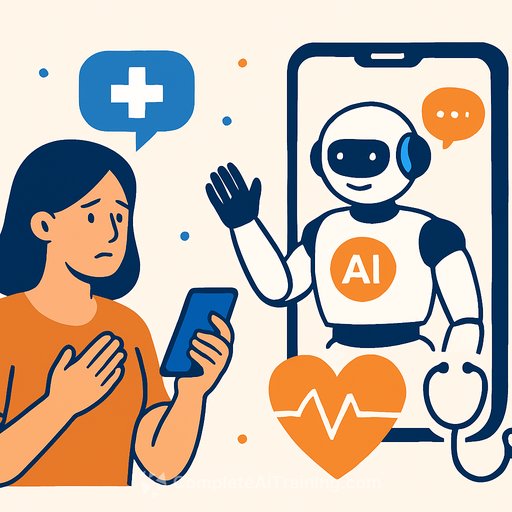
AI is moving from pilot to practice across U.S. health systems. A recent survey shows nearly one-third of organizations now pay for commercial AI licenses. OpenAI reports that about 40 million people use ChatGPT daily for health questions, and it has launched ChatGPT Health to help analyze test results, prepare for appointments, and provide general guidance. Anthropic's Claude for Healthcare is targeting clinical workflows and patient education.
Hospitals are partnering - with guardrails
Memorial Sloan Kettering Cancer Center (MSK) is partnering with OpenAI while exploring responsible use across research, patient education, and administrative operations. "Over the next year, we'll identify where these tools can add value, evaluate them carefully and work toward scaling them responsibly," said Dr. Anaeze Offodile II, MSK's Chief Strategy Officer. He added, "I don't think we can walk back to a world before generative AI. The key question now is how we make sure it's used responsibly."
Dermatology: promising gains in detection and workflow
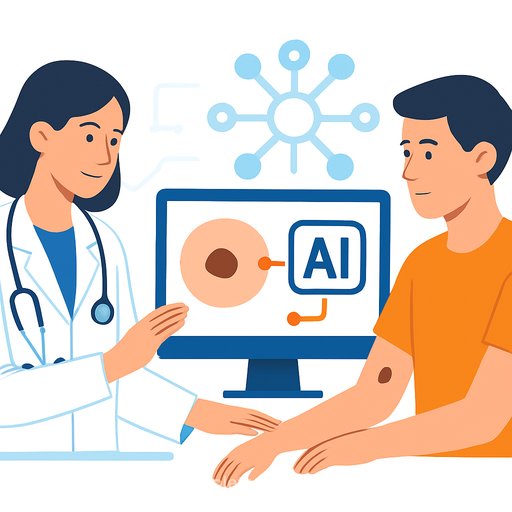
MSK's Dermatology Lab is testing tools that analyze medical images and patient data to flag suspicious lesions and identify higher-risk patients. Dr. Veronica Rotemberg, who leads the dermatology informatics program, says the priority is to test these systems in real clinical settings to quantify impact.
One system uses 92 synchronized cameras to create a 360-degree total-body image set, helping AI track new or changing lesions over time - work that's currently manual and time-intensive. Another, reflectance confocal microscopy, provides sub-surface detail and can detect melanoma with about 80% accuracy. Roughly 112,000 Americans are diagnosed with melanoma each year, according to the American Cancer Society. See ACS melanoma statistics.
As Rotemberg notes, the clinical goal is to find all cancers while avoiding unnecessary biopsies. Improving specificity helps reduce procedures patients don't need, while keeping sensitivity high for what matters most.
Point-of-care and remote screening
Clinicians are also evaluating an AI-enabled dermatoscope that attaches to a smartphone for quicker assessments. This could expand screening to primary care, urgent care, or remote sites without on-site specialists. Even so, "These technologies still require clinical judgment," Rotemberg said. They support physicians; they don't replace them.
Practical takeaways for healthcare leaders
- Start with narrow, valuable use cases: imaging triage, patient education, intake summarization, prior auth support, and scheduling assistance. Define success metrics upfront.
- Stand up governance early: safety, bias monitoring, privacy, audit trails, human oversight, and clear escalation paths.
- Vet vendors like any clinical system: BAAs, PHI handling, data retention, model update cadence, downtime plans, and EHR integration options.
- Pilot in controlled settings: measure sensitivity/specificity, impact on unnecessary procedures, time saved, and clinician satisfaction before scaling.
- Close the education gap: train staff on effective prompting, limitations, and documentation standards. Provide patient-facing education on what AI can and cannot do.
- Prioritize equity: validate performance across skin tones, demographics, and care settings; monitor for drift and disparities.
- Protect the relationship: maintain clinician-in-the-loop workflows and ensure patients know who is accountable for care decisions.
Consumer apps: proceed with caution
Physicians warn that public-facing AI health apps can be inconsistent and should never replace professional evaluation. Use them for general guidance at most, and keep clinical care decisions in the exam room with trained professionals.
Where this is heading
Partnerships between health systems and AI companies are set to grow, with a focus on measurable outcomes, safer workflows, and responsible scaling. The hospitals that benefit most will combine disciplined evaluation with clinician-in-the-loop design and clear communication with patients.
Further learning
If you're leading AI adoption or building staff skills, explore curated education by role: Complete AI Training - Courses by Job.
Your membership also unlocks: