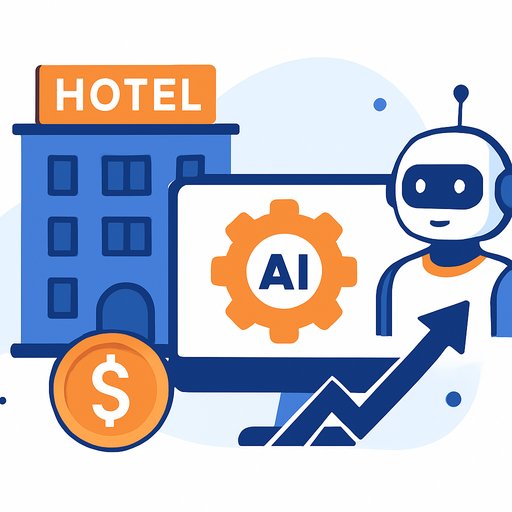
Hotels Are Pouring Money Into AI. Your Sales Engine Still Decides Who Wins
2025 has been a mixed bag for hotel performance. U.S. profitability slipped again, Europe and Asia stayed flat, and the Middle East nudged up. Costs are up, demand is uneven, and the 5% year-on-year growth target many owners expect feels out of reach in several markets.
Tech spend is surging-chatbots, revenue systems, guest comms, automation. Useful, yes. But there's a cap on what software can do if your base business is thin and your sales muscle is weak.
The growth math is different when your market is flat
Five percent growth used to be the minimum to keep pace with inflation and owner expectations. If your comp set is barely holding even, you need to pull levers that move actual share, not just dashboards. That starts with a resilient mix of segments and a disciplined sales operation.
Small vs. large hotels: where tech fits-and where it doesn't
Smaller properties can win with a lean, property-built stack: clean distribution, strong conversion, slick direct booking, and smart rate fences. Keep it tight and measurable.
Complex hotels need more than systems. You need base you can yield from: weekday corporate, shoulder MICE blocks, airline or crew, government, plus leisure that actually uses F&B, spa, and meeting space. No tool substitutes for a pipeline that covers seasons, days of week, and space utilization.
Your clients got sharper. Your sales team has to match them
Across markets, sales and events teams have shrunk, while buyer sophistication jumped. Clients have more options, more data, and less patience. Many hotel sellers were pushed into admin mode-RFP answering, proposal sending, system babysitting-at the cost of prospecting and closing.
That's fixable. But it requires focus, coaching, and incentives that reward productivity, not busywork.
A practical playbook to rebuild your commercial engine
- Define your mix by day and season: target volume, ADR, and total spend for Corporate, MICE, Leisure, Airline/Crew, and Government.
- Set base thresholds: secure minimum weekday corporate and crew before chasing high-yield peaks.
- Enforce speed: under 30 minutes for lead acknowledgment, under 2 hours for a first proposal, same-day alternatives if dates or space shift.
- Qualify with intent: Dates locked, Decision process, Budget range, Roomnights/Peak, Space needs, Ancillary spend (F&B, AV, spa, parking).
- Standardize proposals: tight templates with dynamic value adds; personalize one section that proves you listened.
- Upgrade outreach: daily prospecting blocks, weekly pipeline reviews, monthly QBRs with the top 20 accounts.
- Negotiate with fences: rewards for early commit, length-of-stay, shoulder nights, F&B minimums, and flexible meeting times.
- Maximize total revenue: meeting space yield, upsell executive floors, pre-sell coffee breaks, lunch, and group dining.
- Coach weekly: live call role-plays, objection handling, competitor positioning, and rate defense.
- Pay for outcomes: tie incentives to RGI/RevPAR Index, GOPPAR, TRevPAR, lead response, and stage-by-stage conversion.
- Control tool sprawl: one CRM, one proposal tool, clear integrations; kill anything your team doesn't use weekly.
- Track win/loss: log reasons, price gaps, and competitors; adjust offers and fences based on patterns, not hunches.
Smart tech spend that actually helps sales
Buy what removes friction. CRM tightly integrated with PMS and RMS, RFP automation with e-signature, meeting space diagramming clients can edit, and call intelligence for coaching. Pilot for 90 days, set two or three hard metrics (response time, conversion, proposal cycle), and cut fast if results aren't there.
If you're upskilling your team on AI for prospecting, proposals, and admin automation, curate training that maps to daily tasks, not theory. A focused library of short courses can speed adoption without creating chaos. For curated AI courses by role, see Complete AI Training.
KPIs that keep you honest
- Lead response time: median under 60 minutes.
- Proposal turnaround: under 24 hours for new, under 12 hours for revisions.
- Conversion: inquiry-to-proposal, proposal-to-definite, definite-to-repeat by segment.
- Base coverage: percent of target roomnights locked by 90/60/30-day windows.
- Rev mix: total revenue per occupied room and meeting space revenue per available square meter/foot.
- F&B capture: group and transient capture rates by daypart.
- Indexing: RGI/RevPAR Index and MPI/ARI/RGI trended vs. comp set.
Your edge isn't AI. It's the people who know how to use it
Tech gives you speed and reach. Your sales pros create momentum-relationships, base business, and the confidence to price for value.
Invest in both. Train hard, simplify tools, and give your team the time and incentives to sell. If your market stalls, the hotel with the sharper sales engine still takes share.
For practical sales development resources in hospitality, also check HSMAI.
Your membership also unlocks: