AI Explored as Tool to Improve Governance in Managing Public Health Crises
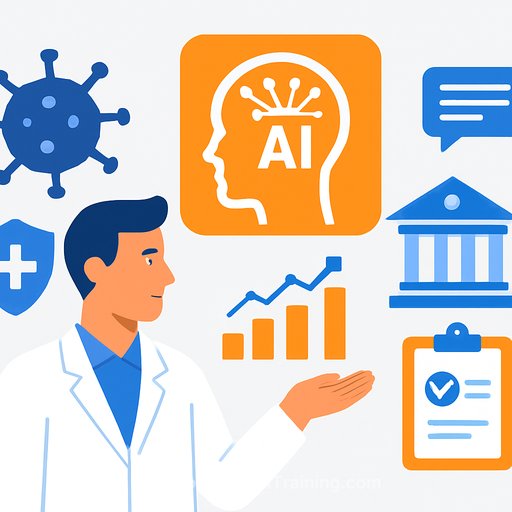
AI can help leaders cut through noise during outbreaks and make decisions faster. The goal isn't flash-it's getting the right signal to the right person at the right time, with checks that keep the system safe and fair.
Government and healthcare teams can use AI to tighten coordination, spot risk earlier, and direct resources with less waste. The impact comes from structure and accountability, not hype.
What AI Can Do Right Now
- Early warning: anomaly detection across syndromic reports, lab feeds, and wastewater trends. See CDC's wastewater guidance for context on surveillance value here.
- Capacity forecasting: predict ICU load, staffing gaps, oxygen use, and PPE burn rates to prevent bottlenecks.
- Resource allocation: prioritize test kits, antivirals, and mobile clinics using geospatial risk and vulnerability scores.
- Public communication: summarize guidance consistently, detect misinformation patterns, and generate clear answers for call centers-always with human review.
- Equity monitoring: track disparate impact by ZIP code or demographic group and flag interventions that need adjustment.
Governance Principles That Make AI Safe and Useful
- Define the decision: tie each model to a specific action (e.g., "trigger surge staffing when forecasted ICU occupancy exceeds X% for Y days").
- Human oversight: keep clinicians, epidemiologists, and emergency managers in the loop for all high-stakes calls.
- Privacy and data minimization: use the smallest data needed; de-identify by default; log every access.
- Fairness: run pre-deployment bias tests; monitor outcomes by subgroup; document mitigations.
- Transparency: publish a plain-language model card (purpose, data sources, limits, contact). WHO's guidance on AI ethics is a useful reference here.
- Security: isolate models and data; enforce least privilege; red-team for prompt and data leakage; plan rollback paths.
- Standards: prefer interoperable data formats (e.g., HL7 FHIR), traceable datasets, and versioned models.
Operating Model for Government + Health Systems
Stand up a small "AI Response Cell" that connects public health, hospitals, EMS, IT, legal, and communications. Give it a clear mandate and a single accountable owner.
- Assign an executive sponsor and an on-call duty officer for decisions.
- Adopt a procurement playbook with safety, privacy, and performance checklists baked in.
- Set data-sharing MOUs with labs, payers, and providers before an emergency starts.
- Publish a public engagement plan: what data is used, how it's protected, and how residents can appeal or ask questions.
Minimal Viable Stack
- Data intake: EHR feeds, labs, 911/EMS, wastewater, pharmacy, and verified public sources.
- Integration: streaming + batch pipelines with quality checks and deduplication.
- Model layer: a vetted library for forecasting, anomaly detection, triage, and summarization.
- Decision layer: dashboards mapped to playbooks, with thresholds, alerts, and override controls.
- Audit: immutable logs for data lineage, model versions, prompts, and decisions.
Quick Wins in 90 Days
- Pick one decision that matters (e.g., "where to send mobile testing tomorrow").
- Run a pilot in one region; shadow-test the model against historical data before going live.
- Red-team for bias, hallucinations, and data leakage; fix or block failure paths.
- Write the SOP: who reviews, how to escalate, when to pause.
- Publish a short transparency note and a community feedback channel.
Policy and Compliance Essentials
- Complete a privacy impact assessment and threat model for each use case.
- Maintain model cards, data retention schedules, and third-party risk reviews.
- Align with HIPAA/GDPR where applicable; define de-identification rules and re-identification penalties.
- Set an incident process for model failures or data issues, including notification timelines.
People and Training
Tools don't fix gaps in skills. Upskill staff in data literacy, prompt craft, validation, and public communication so they can use AI responsibly under pressure.
If you need structured options, see role-based learning paths for public sector and healthcare teams here.
Bottom Line
AI won't run a crisis for you. It can give leaders faster, clearer signals and better options-if you set objectives, enforce guardrails, and keep humans accountable for the call.
Your membership also unlocks: