Life and AI at NASA: How AI Is Changing Scientific Practice in the Search for Life
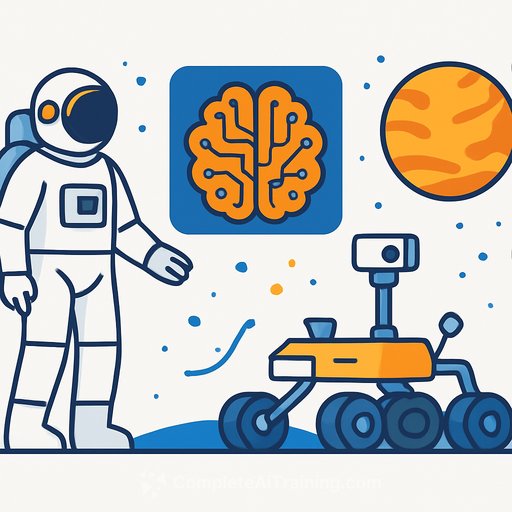
This doctoral thesis examines how Artificial Intelligence is altering day-to-day science inside NASA's most ambitious missions. The work follows scientists and engineers at NASA's Goddard Space Flight Center as they build AI tools to investigate signs of present or past life on other worlds. The focus spans future missions to Mars and Saturn's moon Titan, where AI will be asked to sift signal from noise under extreme constraints.
For context on these efforts, see NASA's programs on Mars exploration and the Dragonfly mission to Titan.
What challenges does the study address?
NASA carries major influence over how we learn about the universe, yet those claims build from local labs, field sites, and tools. The study shows how introducing AI changes what counts as evidence, how teams prioritize data, and how findings are interpreted. It traces the practical work of engineers and scientists developing AI systems intended for Mars and Titan mission concepts.
Main findings
AI tools reflect the data they learn from. Much of that data comes from terrestrial analogs-like the Atacama Desert-because they are accessible, famous, or convenient to study. That skews training sets toward phenomena that are charismatic or useful for industry, which can misalign with planetary science priorities.
AI also introduces new decision points about which data are "valuable." Those choices should be negotiated with domain experts, not left solely to programmers or availability. This is even more critical with synthetic data, where entire datasets can be produced without field constraints and may encode unexamined assumptions.
Why this matters for research teams
When discovery is on the line, data provenance and expert judgment are not optional. The thesis highlights practical risks and opportunities in building AI for science: how datasets are assembled, who decides what gets labeled, and how models are validated across environments that do not resemble Earth. For related methodological resources, see Research.
Practical checklist for AI in planetary science
- State the scientific targets first. Define the phenomena and thresholds that matter to mission science before curating data.
- Document provenance. Track where every sample comes from, why it was chosen, and who labeled it (think datasheets and model cards).
- Balance analog data. Counterweight "charismatic" sites with less popular but scientifically relevant environments.
- Keep experts in the loop. Require domain review at data selection, labeling, and model acceptance stages.
- Plan cross-environment tests. Evaluate on sites and conditions not seen during training to surface brittle behavior.
- Govern synthetic data. Specify generation assumptions, physical constraints, and validation against real measurements.
- Quantify uncertainty. Report confidence alongside predictions, and define operational cutoffs tied to mission risk.
- Audit post-deployment. Log failures, retrace data decisions, and revise datasets with expert input-not just more of the same data.
Field site and method
The research is grounded in ethnographic fieldwork with scientists and engineers at NASA Goddard Space Flight Center. By observing tool-building in context, the study connects AI design choices to scientific claims about life beyond Earth.
Read the thesis
Life and AI at NASA: An Ethnography of How Scientists and Engineers Make Tools to Explore Other Worlds
Public defence
Date and time: 30 January 2026 at 13:15
If your team is building applied AI capabilities for scientific work, explore the AI Learning Path for Training & Development Managers at Complete AI Training.
Your membership also unlocks: