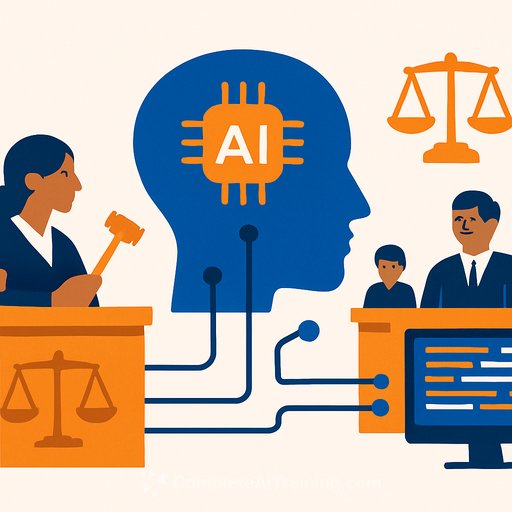
Justice at Your Fingertips: How AI is Helping Delhi’s Judges and Lawyers Manage Caseloads
Delhi’s courts are overwhelmed. With nearly 15 lakh pending cases in lower courts alone—including 12.9 lakh criminal and 2.13 lakh civil cases—the backlog is staggering. The Delhi High Court operates with less than one judge per 10 lakh population, and an estimated 300 years would be needed to clear existing case delays at the current pace.
Shortages of judges, court staff, and even basic infrastructure like chambers for advocates make the situation worse. Manual processes slow everything down, and court personnel spend valuable time on paperwork rather than legal analysis.
Artificial Intelligence Steps In
AI offers practical tools to ease these burdens. It can automate routine tasks while judges focus on delivering justice. For example, AI-powered speech recognition helps court stenographers transcribe witness examinations and judicial orders quickly and accurately.
One notable AI solution is Adalat AI, co-founded by lawyer Utkarsh Saxena, which provides machine learning tools tailored for India’s courts. The platform reduces paperwork by enabling judges to dictate their orders, which are then automatically transcribed with precise legal terminology.
Saxena highlights the logistical delays that cause most backlogs, not legal complexities. “Our goal is to eliminate these delays,” he says. “Tools run quietly in the background to speed up slow processes and free judges to focus on justice.”
How Adalat AI Works
- Judges simply log in, press two buttons, and speak their observations.
- The software transcribes speech accurately, including legal jargon and Indian accents.
- Orders are automatically prepared and can be downloaded as ZIP files at day’s end.
- A case flow management dashboard streamlines workflows, similar to a digital cause list.
The AI has been trained on over 1 lakh court orders in 11 local languages, making it uniquely suited to India’s diverse legal environment. Currently, Adalat AI operates in 3,000 courtrooms across eight states, including Delhi, Kerala, Karnataka, and Punjab. The goal is to cover 50% of all courtrooms nationwide by 2025.
Adalat AI also supports training at judicial academies and maintains direct feedback channels via WhatsApp communities for judges and court staff to report issues—ensuring continuous improvement.
Digitizing Legal Documents and Reducing Clerical Work
Beyond transcription, Adalat AI facilitates scanning and instant conversion of legal documents into digital records. This reduces reliance on physical files, which court staff say consume half their sorting time.
At a 2024 event launching Adalat AI in Delhi’s district courts, then-Delhi High Court Chief Justice Manmohan (now Supreme Court Judge) praised the app for addressing the shortage of stenographers. By automating order transcription, stenographers can be redeployed to other critical tasks.
Lawyers Embrace AI Tools Too
Lawyers are using AI to improve research and case preparation. Advocate Vivek Chandra Jaiswal uses AI apps to extract key points from lengthy judgments, sometimes deploying these insights directly in court arguments.
One such tool is Ask Junior, created by advocate Renu Gupta. It summarizes judgments by parsing facts, legal issues, arguments, and reasoning into concise, accessible digests. The tool has summarized over 14,800 judgments with 96.1% accuracy and serves thousands of subscribers through monthly digests of Supreme Court decisions.
Ask Junior’s models are trained on publicly available Supreme Court judgments and refined with input from practicing lawyers, ensuring relevance and accuracy.
Language Accessibility in Judgments
To improve access, 17 High Courts now provide online judgment access in regional languages. By January 2025, over 36,000 Supreme Court judgments had been translated into Hindi, and more than 42,000 into 17 other regional languages.
The Supreme Court has also adopted AI language technology to assist in translating judicial documents, enhancing transparency and understanding for litigants and legal professionals across linguistic backgrounds.
What This Means for Legal Professionals
AI-powered tools like Adalat AI and Ask Junior are streamlining tedious tasks, reducing clerical workloads, and improving research efficiency. For judges, lawyers, and court staff in Delhi and beyond, these technologies offer practical relief from the crushing backlog.
Legal professionals interested in expanding their AI skills and exploring how these tools can further support their work may find valuable resources at Complete AI Training.
As AI continues to integrate into the judicial process, the focus remains clear: automate the routine, accelerate case handling, and empower legal minds to deliver justice more effectively.
Your membership also unlocks: