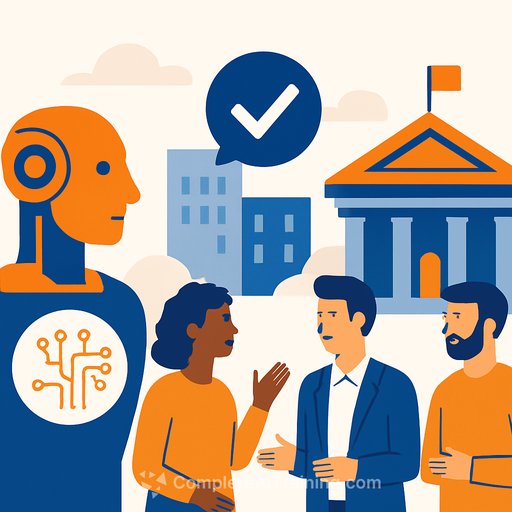
How AI Can Support Self-Government
Applying artificial intelligence to government presents risks but also offers a chance to decentralize power in meaningful ways. With public trust in institutions falling, many wonder who truly governs and whether dysfunction has become permanent. Restoring America’s tradition of self-government requires new tools and renewed citizen engagement.
Recent polling shows trust in Congress remains low, yet confidence in local government is significantly higher. This gap highlights the importance of government representatives sharing common interests and values with their communities. Washington’s partisan gridlock and fiscal challenges have created distance between citizens and their government, eroding civic identity and local responsibility.
Reversing this trend means embracing the bottom-up approach that shaped America’s founding. Citizens and families need more influence over their communities. Surprisingly, artificial intelligence—often feared as a threat to human control—can reconnect people with local government and elected officials.
AI as a Tool for Citizen Engagement
AI can empower citizens by providing access to government information and enabling active participation. One example is CitizenPortal.ai, which transcribes and indexes public meetings nationwide. Users receive alerts on topics relevant to their communities, allowing them to monitor and engage with government decisions more effectively.
This technology offers a new model for public involvement, transforming citizens into watchdogs who hold officials accountable. By simplifying access to government proceedings, AI can help shift power back to an informed and active citizenry.
Streamlining Government Transparency and Accountability
CitizenPortal.ai and similar tools could replace slow Freedom of Information Act (FOIA) processes with instant, searchable access to government activities. This strengthens local governance and compensates for the decline of traditional local media, which once played a crucial role in oversight.
New platforms like WONK provide straightforward explanations of state legislation, helping residents understand bills without needing legal expertise. As users interact with these platforms, AI improves its ability to clarify complex policy details, making government more accessible.
AI in Regulatory Reform and Efficiency
Ohio’s Reg Explorer demonstrates AI’s potential to modernize government by reviewing and recommending the elimination of outdated regulations. This project has identified millions of unnecessary words and hundreds of obsolete rules, streamlining governance and saving millions in costs and labor hours.
Such initiatives show AI can support a culture of reform, empowering government staff to update laws while maintaining transparency and accountability. This contrasts with fears that AI might replace governance—rather, it enhances human decision-making and oversight.
Ensuring Constitutional Fidelity
AI tools can analyze legislation for constitutional concerns, flagging issues such as excessive delegation of authority or threats to free speech and religious freedoms. While AI cannot replace constitutional scholars, these tools provide valuable assistance for citizens and lawmakers to review bills critically.
Using AI to assess government actions can help maintain federalism by highlighting the impact of federal funds and regulations on state autonomy. This assists legislators in resisting federal overreach and protecting local control.
State Leadership in AI Governance
States have taken the lead in regulating AI, with initiatives like California’s executive order emphasizing cautious deployment to mitigate risks. Experts advocate for embracing AI to improve government services while addressing data privacy, bias, and free speech concerns.
State and local governments can demonstrate competence in AI governance, fostering public trust and setting examples for national policy.
Preserving Human Leadership and Values
The most significant limitation of AI is that it cannot replace human judgment or presence. The unique qualities of human creativity, moral reasoning, and community connection remain essential. Leaders and citizens alike must remember that technology complements—not substitutes—the virtues needed for self-government.
As AI tools develop, the responsibility to use them wisely lies with the people. Maintaining constitutional norms and local engagement will be key to ensuring AI supports freedom and democracy rather than undermines them.
Conclusion
AI holds promise for strengthening self-government by enhancing transparency, citizen participation, and regulatory efficiency. With thoughtful implementation and active oversight, AI can help return power to local communities and individuals. The future of governance depends on combining technological tools with committed, principled leadership and engaged citizens.
For government professionals interested in expanding their understanding of AI’s role in public service, exploring resources like Complete AI Training can provide valuable insights into practical applications and ethical considerations.
Your membership also unlocks: