Bridging the Gap in Urban Planning with AI
Cities collect vast amounts of data, but this information often remains underused because government officials struggle to analyze and communicate it effectively. Sarah Williams, a professor of urban planning and technology at MIT, noticed this disconnect early in her career. She observed that valuable academic research was not reaching the people who could translate it into better urban design and policy.
To address this, Williams founded the Civic Data Design Lab in 2012. The lab focuses on making urban data accessible and engaging through compelling visuals and storytelling. Their projects include mapping incarceration rates in New York City neighborhoods—work that is now part of the Museum of Modern Art's permanent collection—as well as tracking air pollution in Beijing and mapping Nairobi’s daily commutes using geographic information systems.
The Role of AI in Urban Planning
As AI tools become more accessible, cities face both opportunities and challenges in integrating them into government functions. Williams emphasizes the importance of transparency about how AI is used and its limitations. AI can process and visualize large datasets quickly, but it also raises concerns around misinformation and misuse.
In 2024, Williams collaborated with Boston’s Office of Emerging Technology to observe how AI applications could support city operations. This partnership led to the publication of the Generative AI Playbook for Civic Engagement, a resource designed to help city governments leverage AI responsibly while managing risks.
With limited federal regulation on AI, Williams points out that nonprofits and academia play a key role in guiding local governments. The playbook covers diverse applications, including virtual assistants for procurement, traffic signal optimization, and chatbots for nonemergency services. The main focus remains on improving civic engagement by making government more responsive and understandable to residents.
Enhancing Civic Engagement
Today’s civic engagement largely happens through social media, websites, and community meetings. AI offers tools to close the communication gap between governments and residents. One example from Boston uses a large language model to summarize 16 years of City Council votes into simple, searchable descriptions. This helps residents quickly find information on topics like housing initiatives or migrant shelter expansions.
AI also helps government officials analyze the vast amount of community input collected through 311 calls, surveys, and public meetings. Boston recorded nearly 300,000 311 requests in 2024, mostly parking complaints, while New York City logged 35 million in 2023. AI can detect geographic patterns in these requests, making it easier to prioritize and respond.
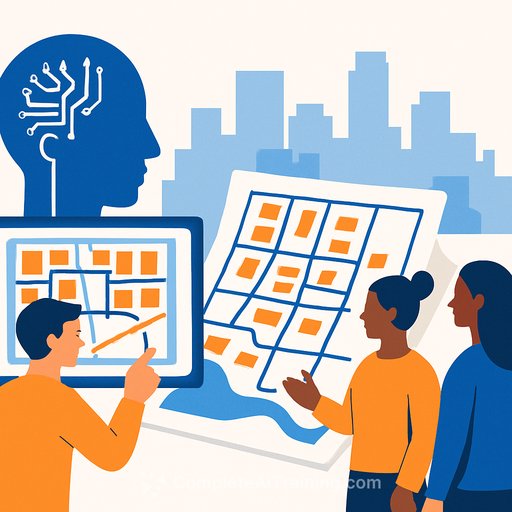
At a Boston community meeting, staff used generative AI to instantly map pothole complaints from the previous month. AI-powered platforms like Polis, an open-source polling tool used internationally, are also experimenting with AI to categorize and summarize public responses. This could support more direct forms of democracy by helping residents’ voices be heard clearly and efficiently.
Caution and Trust in AI
Despite these advances, caution is necessary. AI should enhance human decision-making without replacing it. Misinformation remains a serious issue, illustrated by instances where city chatbots provided inaccurate or misleading answers. For example, New York City’s chatbot once erroneously stated that rat-bitten cheese could be legally served in restaurants. Although improvements have been made, such errors erode public trust.
Williams stresses the importance of human oversight and transparency about AI’s capabilities and limits. Building trust means being upfront with residents about how AI is used in government and ensuring that human facilitators remain involved in the process.
Future Directions
Looking ahead, Williams aims to help cities develop their own AI systems instead of relying on large tech companies. Open-source AI models controlled by communities would allow residents to understand and own the data they generate. This approach addresses concerns about unpaid labor behind AI training and promotes greater community control over technology.
By owning their AI tools, cities can better align technology with public interests and increase access to vital information. This shift could empower governments to use AI more ethically and effectively in service of their residents.
Your membership also unlocks: