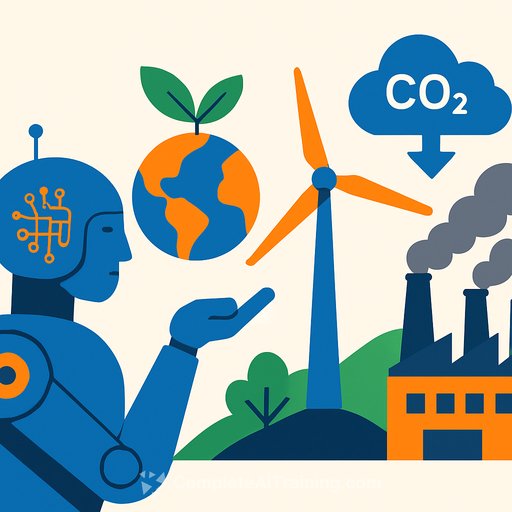
Can AI Reduce More Emissions Than It Produces?
Artificial intelligence (AI) and its energy-intensive data centers are often criticized for their environmental impact. However, new research suggests that AI could actually help cut global climate emissions by up to 5.4 billion metric tons annually over the next decade. This reduction would more than offset the carbon footprint created by powering AI systems.
The study from the Grantham Research Institute, published in npj Climate Action, highlights that the key to achieving these benefits lies in applying AI effectively to areas like transportation, energy, and food production. Governments have a critical role in guiding this process, ensuring AI development minimizes environmental harm and maximizes positive climate outcomes.
Balancing AI’s Energy Use with Emission Cuts
Data centers supporting AI require significant electricity, and their growing demand challenges current energy grids. The International Energy Agency projects data center electricity use will double by 2030. Meanwhile, fossil fuels are expected to supply much of this increased power, which could undermine efforts to reduce carbon emissions.
Yet, the Grantham study outlines practical ways to mitigate these concerns. It calls for:
- Developing energy-efficient AI models.
- Powering data centers with renewable energy.
- Investing in AI infrastructure and education, especially in developing countries.
- Regulating AI to minimize its environmental footprint.
Five Areas Where AI Can Cut Emissions
The study identifies five key sectors where AI can drive meaningful emission reductions:
- Consumer behavior: AI can encourage sustainable choices and optimize resource use.
- Energy management: AI improves grid efficiency by forecasting supply and demand, facilitating renewable energy integration, and reducing reliance on polluting backup power.
- Technology innovation: AI accelerates advances such as better batteries for electric vehicles, lowering costs and increasing adoption.
- Food production: AI assists in discovering alternative proteins to replace emissions-heavy meat and dairy products.
- Transportation: AI promotes shared transport options and electric vehicle usage, cutting emissions from traditional vehicles.
Combined, these applications could reduce annual carbon dioxide equivalent emissions by between 3.2 and 5.4 billion metric tons by 2035. To put this into perspective, these savings exceed the total emissions of the European Union and come close to half of the United States’ 2023 emissions.
Challenges and the Role of Policy
While promising, the study acknowledges limitations. It focuses on current AI applications in three sectors and may underestimate future potential. It also does not fully account for the risk that efficiency gains could lead to increased consumption elsewhere, potentially offsetting some emission reductions.
Despite these uncertainties, the evidence suggests that AI’s benefits can outweigh its environmental costs if managed correctly. Active government involvement is essential to guide AI development, regulate energy use, and ensure equitable access to AI-driven solutions worldwide.
For professionals interested in expanding their AI knowledge and exploring its applications in energy and sustainability, comprehensive learning resources are available at Complete AI Training.
Conclusion
AI’s growing energy demands are a valid concern, but its potential to reduce emissions across multiple sectors offers a powerful tool against climate change. With thoughtful regulation, investment in clean infrastructure, and targeted applications, AI could become a significant asset in efforts to limit global warming.
Your membership also unlocks: