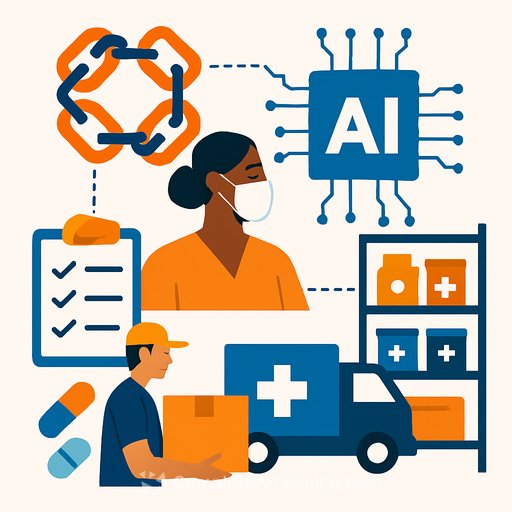
How Blockchain and AI Improve Medical Supply Chains
Recent health crises have exposed weak points in medical supply chains, emphasizing the need for systems that are both transparent and resilient. A new approach combines blockchain technology with AI-powered multi-agent negotiation to meet these demands.
Autonomous agents represent manufacturers, distributors, and hospitals, negotiating resource allocation during disruptions. These negotiations are guided by large language models (LLMs), while blockchain ensures decisions are transparent and auditable.
Strengthening Supply Chain Resilience and Transparency
This framework merges the security of blockchain with the adaptive intelligence of LLMs to create a dynamic network that can respond to shifting conditions. Unlike traditional supply chains, which often suffer from inefficiencies and rigidity, this system adapts in real-time to resource scarcity and demand fluctuations.
All decisions made by the agents are recorded on the blockchain, providing an immutable, transparent ledger that enables trust and accountability. This transparency is crucial for healthcare providers and suppliers working under pressure.
Performance in Crisis Simulations
- The system maintained a 100% service level, meaning all demands were met without stockouts, even during fluctuating regional outbreaks.
- Blockchain transactions were completed in under 20 milliseconds with low computational cost, enabling real-time tracking and auditing.
- The negotiation process was faster and fairer compared to traditional approaches.
The combination of blockchain and LLM-powered agents is novel in this context. Blockchain typically supports traceability, but here it enforces agreements resulting from autonomous negotiations, allowing for flexible responses as situations evolve.
Limitations and Future Directions
While promising, the model currently simplifies some real-world factors. It does not fully simulate cascading failures, geopolitical impacts, or the subtleties of human negotiation. Agent behavior remains deterministic, which limits adaptability in complex scenarios.
Future research will extend testing to larger, more diverse networks and longer crisis periods. It will also explore cost-performance balances for real-world deployment and incorporate more adversarial conditions.
Practical Benefits for Healthcare Supply Chains
This approach offers healthcare professionals a tool to coordinate critical medical supplies more efficiently and fairly during emergencies. The transparent, automated negotiation process can reduce delays and conflicts over scarce resources.
The integration of blockchain with AI agents ensures decisions are secure, auditable, and consistently enforced, building trust among all parties involved.
For healthcare professionals interested in AI applications and supply chain improvements, exploring courses on AI and automation can provide valuable insights. Visit Complete AI Training’s latest AI courses for more resources.
Your membership also unlocks: