Why Coca-Cola’s CIO Focuses on High-Impact AI Pilot Projects
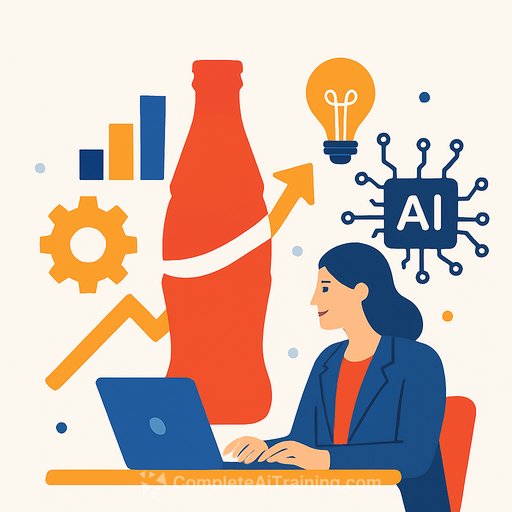
Neeraj Tolmare, senior vice president and chief information officer at Coca-Cola, sets a clear standard for the company’s AI investments. Each pilot project must demonstrate clear potential for revenue growth or significant efficiency improvements before getting the green light. This approach aligns with CEO James Quincey’s directive that AI experiments must deliver tangible outcomes that move the needle at scale.
For a company as vast as Coca-Cola—ranked 97th on the Fortune 500—scale means everything. Tolmare weighs the cost of implementation alongside the technology’s potential to impact multiple internal functions, from software development to sales. He also considers how emerging AI technologies, such as agentic AI, will affect workflows and data sharing across Coke’s extensive network of 200 bottlers and 950 production facilities, which together serve 2.2 billion beverages daily.
AI in Retail Demand Prediction
One promising AI pilot involves an algorithm to help retail outlets predict demand more accurately, ensuring shelves stay well stocked. Previously, sales agents visited stores every few weeks, sometimes encountering half-empty coolers. Coca-Cola relied mainly on historical retail scan data to forecast demand.
The new AI algorithm improves predictions by combining historical sales data with weather patterns—an important factor for beverage purchases—and geolocation data from Google. These insights drive targeted WhatsApp messages to store managers, advising when to restock popular products like Sprite or Diet Coke.
Tested in three countries, this pilot led to a 7% to 8% sales increase compared to outlets not using the AI tool. Tolmare plans to expand this approach to more markets globally, demonstrating how AI can directly boost sales performance.
AI-Driven Content Creation at Scale
Coca-Cola’s marketing team faces the challenge of creating assets in over 130 languages to serve 180+ countries. This is resource-intensive due to the need for language translation and cultural adaptation.
To address this, Coca-Cola generated 20 AI-created marketing assets based on proprietary intellectual property, then produced 10,000 variations for different languages and regions. The results are striking: consumers are 20% more likely to engage with AI-enhanced content, and production time has been cut by two-thirds.
However, Tolmare emphasizes the need to keep humans involved. The company has strict guidelines to prevent AI-generated content from including social biases or inaccuracies. For example, Coke faced backlash from an AI-generated Christmas ad last year and a campaign featuring a misattributed quote. The company has mechanisms to respond responsibly if AI output causes issues.
Balancing AI Innovation with Practicality
Tolmare’s background is rooted in technology companies like Palm, Cisco, and HP, giving him deep experience in both developing and deploying technology. Since joining Coca-Cola in 2018, he has led the company’s shift to cloud computing, retiring physical data centers in favor of Microsoft Azure (80% of the footprint), Amazon Web Services, and Google Cloud.
This hybrid cloud approach also guides Coca-Cola’s AI strategy. The company works closely with Microsoft and OpenAI but also explores AI tools from Google, Meta, and Anthropic to avoid early vendor lock-in. Tolmare notes that the AI market remains diverse and dynamic.
Looking Ahead: Agentic AI Pilots
The next frontier for Coca-Cola’s AI efforts is agentic AI—systems capable of autonomous or semi-autonomous task execution. The company is evaluating solutions from Microsoft, SAP, and Adobe while developing custom AI agents trained on its own data.
All of these remain in pilot stages as Tolmare focuses on whether they can achieve cost-effective, impactful business outcomes. “We haven’t launched agentic in production yet, but we are very close,” he says. “I’m fascinated by what this can do for our business.”
For IT and development professionals interested in advancing AI skills, exploring structured training and certification can provide a solid foundation. Resources like Complete AI Training offer courses that cover everything from AI fundamentals to specialized applications.
Your membership also unlocks: