Evolving Agencies: Adjusting Paid Search Strategies Amid Google’s AI Overviews
Google’s AI Overviews feature recently marked its first year in the U.S., delivering AI-generated summaries at the top of search results before traditional links. This shift is prompting marketers to rethink how they optimize for both human visitors and AI-driven search crawlers. Established SEO approaches are being questioned as these Overviews have led to significant drops in organic traffic for many publishers and brands.
For example, Mail Online experienced a 56% decline in clickthrough rates after AI Overviews appeared in Google search results. Research from Bain shows that 80% of consumers resolve 40% of their searches without clicking past the search results page. This zero-click trend raises concerns that paid search traffic might also be affected, as marketers rely heavily on paid ads to drive conversions.
Impact of AI Overviews on Paid Search Performance
Though AI Overviews are widespread in the U.S., their presence in the U.K. remains limited but growing. Early data suggests slight decreases in impression share and clickthrough rates (CTR) for broad, informational keywords, which are typically targeted at the top of the funnel. However, paid search performance on mid- to bottom-funnel keywords remains relatively stable.
Paid ads tend to focus on users closer to purchase decisions, whereas AI Overviews primarily appear for early-stage, informational queries. Consequently, while clicks may decline, conversions have not shown significant drops for many clients. This distinction offers some reassurance but also signals a need to monitor search behavior closely.
How Agencies and Marketers Are Responding
Agencies are not waiting to see how the landscape changes; they’re proactively adjusting strategies. Some clients are cautious about running paid ads alongside AI Overviews mentioning their brand, fearing wasted spend or cannibalization of organic clicks. These marketers are reallocating budgets or increasing spend on brand keywords to secure visibility and prevent competitors from hijacking customer journeys.
Many have increased brand keyword budgets by up to 20% to maintain presence when AI Overviews highlight competitors or marketplaces. The focus is on spending smarter, not necessarily less, adapting to the evolving search engine results page (SERP) environment.
Additionally, some agencies report clients boosting investments in broad keywords like “summer dresses,” increasing those budgets by around 10%. This shift aims to capture more clicks earlier in the funnel as AI Overviews reshape user behavior.
There’s also growing interest in paid opportunities within zero-click search environments, such as platforms like Perplexity that integrate AI-generated answers with ads. However, scalability and effectiveness of these options remain under evaluation.
The Road Ahead: AI Overviews and Paid Search
The use of AI Overviews is expected to expand across more search queries. Recent stats show Overviews appeared in 13% of all U.S. desktop searches in March 2025, doubling since January. Agencies are watching closely as Google experiments with AI Mode beta, which offers fully AI-generated responses instead of traditional blue links.
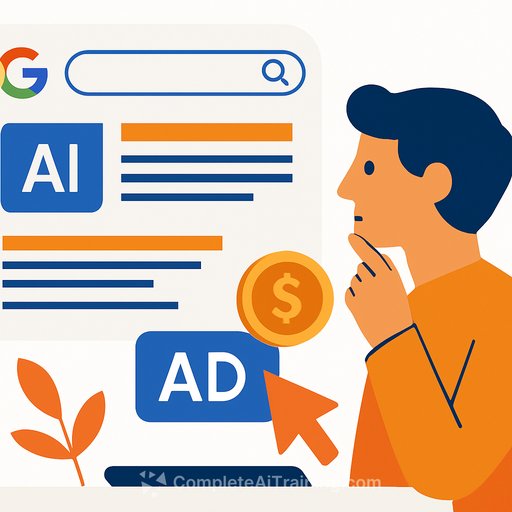
Google already places some ads inside AI Overviews, but advertisers currently cannot purchase this space directly. When that option becomes available, it could significantly impact paid search strategies and budgets.
To stay ahead, agencies are developing tools that provide clients better visibility into how AI models like Google’s Gemini or other large language models influence search traffic and conversions. Services range from attribution modeling to specialized AI search analysis, helping marketers understand what portion of traffic comes from AI-driven sources and adjust accordingly.
As zero-click searches grow, brands face a fundamental challenge in how they approach both paid search and SEO. The shift demands new tactics and tools to maintain effectiveness in a search ecosystem increasingly shaped by AI.
Key Takeaways for Marketers
- AI Overviews reduce clicks on organic results, especially for early-stage informational queries.
- Paid search remains effective, particularly for mid- and bottom-funnel keywords.
- Increasing brand keyword spend helps protect visibility and conversions as AI Overviews surface competitor links.
- Broad keyword budgets may need adjustment to capture shifting user intent and behavior.
- Emerging paid ad opportunities within AI-powered search platforms are worth monitoring.
- Invest in analytics and attribution tools that account for AI-driven traffic changes.
Marketers looking to sharpen their AI search strategies can explore specialized education on AI and paid search optimization at Complete AI Training.
Your membership also unlocks: