India Is Teaching Google How AI Scales In Schools
AI is moving into classrooms fast. The most useful lessons on scaling aren't coming from Silicon Valley-they're coming from India.
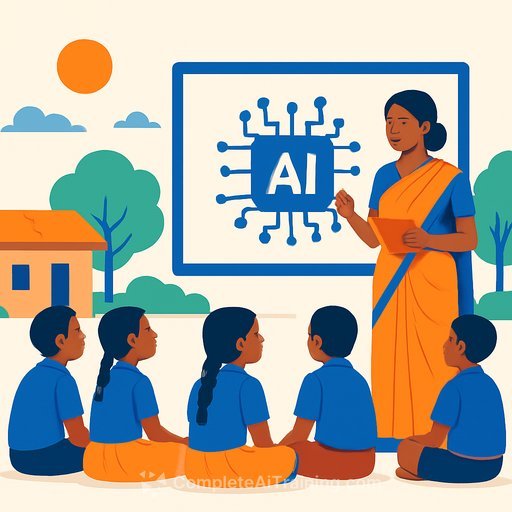
With more than a billion internet users and a vast K-12 and higher-ed footprint, India has become a proving ground for Google's education AI. By Google's account, India now leads global usage of Gemini for learning, inside a system defined by state-led curricula, strong government roles, and uneven access to devices and connectivity.
Why India matters: scale and complexity
India's schools serve about 247 million students across nearly 1.47 million schools, supported by 10.1 million teachers. Higher education adds more than 43 million students. Huge. Decentralized. Unevenly resourced. That mix makes India the perfect stress test for what actually works.
The core lesson: local control beats one product
A single, centrally defined AI product doesn't fit. Curriculum decisions sit at the state level, ministries and boards are active, and institutions need room to make choices. Google has adjusted by building AI that schools and administrators can control-configurable, not prescriptive.
The message: flexibility isn't a feature; it's table stakes.
Keep the teacher at the center
Google is prioritizing teacher-first AI: planning, assessment, and classroom management tools that support educators instead of routing around them. The teacher-student relationship remains the anchor. AI should help teachers do more of the high-value work, not replace it.
Multimodal fits real classrooms
Video, audio, images, and text together are gaining traction, especially across multiple languages and learning levels. This matches classrooms where text-heavy instruction isn't always practical. Multimodal is less about flash and more about reach.
Access is uneven-design for it
Many schools don't have one device per student or reliable internet. Devices are shared. Connectivity drops. Some learners jump straight from pen-and-paper to AI on a teacher's device. "Access is universally critical, but how and when it happens is very different," as Google's education lead put it.
Implication: plan for shared devices, offline workflows, and teacher-led usage-then scale up as infrastructure improves.
What's rolling out in India
- Gemini support for JEE Main prep for engineering aspirants. For official exam info, see the National Testing Agency's JEE page: jeemain.nta.nic.in.
- A nationwide teacher training program for 40,000 Kendriya Vidyalaya educators.
- Partnerships with government institutions across vocational and higher education, including India's first AI-enabled state university.
Competition and policy pressure are rising
OpenAI is building a local education presence. Microsoft is deepening partnerships with institutions and edtech players, including Physics Wallah. The message is clear: education is a core battleground for AI companies.
Policy bodies are also weighing in. India's Economic Survey flags risks from uncritical AI use-over-reliance on automated tools and potential drops in critical thinking. You can review the survey materials here: indiabudget.gov.in/economicsurvey.
What this means for education leaders
India's playbook is a preview for everyone. The pressures around control, access, and localization will surface in other countries. If you're responsible for AI in your system, here's a practical starting point.
A practical checklist you can use
- Governance first: define who approves tools, where data lives, and how usage is monitored. Set permissions by role and age group.
- Teacher-first rollout: start with planning, feedback, rubric-aligned assessment support, and differentiation-then expand to student-facing tools with clear guardrails.
- Plan for multimodal: support video, audio, and image inputs to meet diverse languages and learning preferences.
- Design for low-resource contexts: shared devices, offline/low-bandwidth modes, printable outputs, and teacher-facilitated stations. For teams designing adaptable tools, consider resources like AI Design Courses to build practical, context-aware approaches.
- Localize content: align to state or board curricula. Prioritize major local languages and plain-language prompts.
- Build staff capacity: offer short, practical workshops, micro-credentials, and peer coaching to help teachers integrate AI into existing practice.
Start small, center teachers, and iterate as you learn-India shows that scalable educational AI is less about a single product and more about flexible systems and local ownership.
Your membership also unlocks: