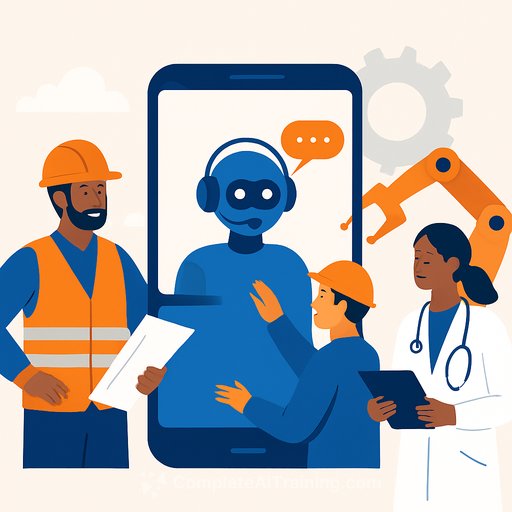
Industries Ready to Use Mobile AI Agents for Greater Operational Agility
Industries with large field operations—like construction, manufacturing, and healthcare—are preparing to integrate mobile AI agents to improve agility and efficiency. Mobile AI is set to transform how field workers operate, bridging gaps between on-site teams and back-office support.
Early mobile apps often struggled with user experience and performance because they were simply web versions squeezed into smaller screens. This led organizations to rethink their approach, moving to a “mobile first” mindset and creating apps that fit specific roles and tasks. Now, with AI agents, we’re seeing a similar shift toward smarter, more adaptive mobile experiences tailored to the field workforce.
Assessing Your Readiness for Mobile AI Agents
Operations leaders should evaluate current mobile apps and SaaS tools to identify where AI can add real value. Focus on apps that support core field workflows, involve many field workers, or handle large volumes of real-time data. These are prime candidates for AI enhancement.
Another opportunity lies in workflows that are still manual or disconnected between field and office teams. Centralizing data and ensuring seamless communication is essential before layering AI on top.
- How critical is the app to daily field operations?
- How many workers use it, and how often do they interact with office staff?
- Does the app handle large amounts of data that impact quick decisions?
Reviewing your IT infrastructure is equally important. Outdated systems and cybersecurity gaps can slow AI adoption. Nearly all manufacturers report legacy infrastructure as a key barrier, yet few have fully assessed readiness.
Strong infrastructure, upskilling teams, and clear AI governance policies are needed to deploy AI responsibly and effectively.
How Mobile AI Agents Will Change the User Experience
Current field mobile apps mostly rely on forms, checklists, and static dashboards. AI agents will shift this by acting more like teammates than tools. Instead of navigating menus, workers will interact with AI through prompts and personalized data views that anticipate their needs.
AI agents will help summarize technical manuals, troubleshoot onsite, suggest next steps, and reduce back-and-forth calls with headquarters. This means faster, more informed decisions right at the job site.
Practical Use Cases for AI Agents in the Field
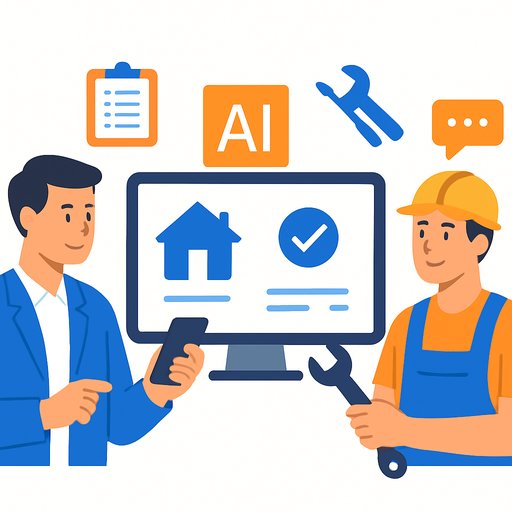
AI won’t replace hands-on tasks like plumbing or equipment repair, but it can handle administrative work—answering calls, preparing quotes, managing invoices—freeing workers to focus on their core skills.
More advanced AI agents provide real-time guidance, predictive task planning, and multilingual support. These tools help workers anticipate issues and adapt workflows dynamically, improving productivity.
For example, a utility technician arriving at a remote site could receive AI-driven alerts about known local issues, safest routes considering weather, and relevant maintenance history—all before starting inspections.
In high-stakes fields like healthcare, AI agents can speed up decisions and increase safety by providing precise, domain-specific insights. However, pairing AI with validated data and transparent processes is critical to avoid errors.
Combining AI Agents with Wearables and 5G for Enhanced Field Support
Fieldwork varies greatly by location and job type. AI agents can partner with engineers to provide step-by-step troubleshooting and surface key information instantly.
Some AI agents work quietly in the background, monitoring equipment health and alerting workers before failures occur. This proactive approach helps optimize maintenance and manage risks effectively.
With faster connectivity like 5G and wearable devices, AI agents can offer multimodal support—text, voice, video tutorials, and augmented reality overlays—directly on equipment. This democratizes expertise, enabling every technician to operate at a higher skill level.
The benefits include reduced downtime, improved safety, and lower costs, making AI agents essential for competitive field operations.
Challenges and Risks When Deploying AI Agents
Despite the clear benefits, IT and operations leaders must be realistic. Early AI applications often focus on simple tasks like time tracking or job reporting. But complex field workflows require solid data foundations.
Without complete and accurate data, AI outputs can be unreliable. Off-the-shelf AI rarely fits complex environments without customization and contextual modeling.
Data privacy and regulatory compliance are major concerns, especially in sensitive industries like healthcare. Sharing confidential data with third-party AI tools requires updated governance frameworks to prevent leaks and legal issues.
Security teams must also assess vendors and internal infrastructure to handle AI safely. Phased rollouts, strong cybersecurity, and scalable systems help reduce risks during adoption.
Vertical AI agents deliver value only when built with domain knowledge and context. Simply adding AI onto existing apps can backfire and slow operations.
Operations leaders should rethink workflows, blending human expertise with AI autonomy to build safer and smarter processes.
Getting Started: Focus on Field Workers' Needs
The best approach is to observe how field engineers currently work and use mobile tools. Talk directly with them, understand their pain points, and explore how AI can make their jobs easier without threatening their roles.
Successful AI integration simplifies fieldwork and boosts value delivery to customers. This grounded perspective ensures AI agents serve as practical teammates, not just flashy add-ons.
Your membership also unlocks: