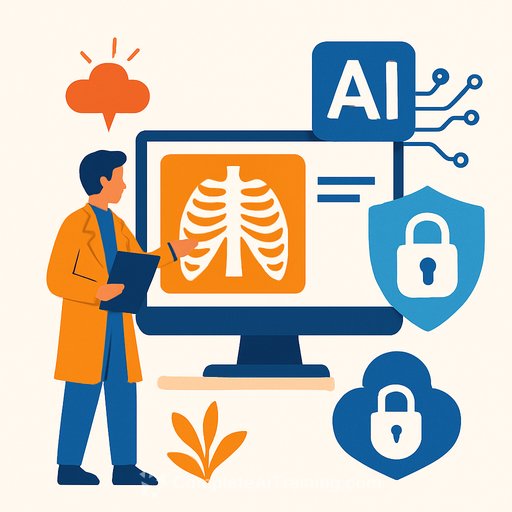
Retrieval-Augmented Generation Enhances Local Large Language Models in Radiology
Large language models (LLMs) have potential to assist clinical decision-making, yet local deployments often lag behind cloud-based systems in accuracy and speed. A recent study by Japanese researchers tested retrieval-augmented generation (RAG) as a way to boost local LLM performance in radiology contrast media consultations.
Using 100 synthetic cases, the RAG-enhanced model eliminated hallucinations entirely, responded faster, and received higher evaluations from AI judges compared to both its baseline version and leading cloud-based models. Published in npj Digital Medicine, these findings indicate that RAG can make local LLMs clinically reliable while keeping sensitive patient data securely onsite.
Addressing Clinical and Privacy Challenges in Radiology
Radiology often requires quick decisions guided by complex clinical protocols, especially for contrast media use. Physicians face pressure to make accurate assessments based on kidney function, allergies, and medications, but may lack immediate access to all relevant information. This challenge intensifies in hospitals that must avoid cloud tools to protect patient privacy.
The team, led by Associate Professor Akihiko Wada from Juntendo University, developed a RAG-enhanced local LLM that dynamically retrieves information from a curated knowledge base including international guidelines and institutional protocols. This approach ensures responses are grounded in verified medical knowledge rather than solely on pre-trained data.
Performance Highlights of the RAG-Enhanced Model
- No hallucinations: Dangerous hallucinations dropped from 8% to 0%, eliminating risks of incorrect contrast dosage or missed contraindications.
- Faster responses: Averaged 2.6 seconds per consultation, outperforming cloud models that took between 4.9 and 7.3 seconds.
- Efficient deployment: Runs on standard hospital computers without the need for costly hardware or cloud subscriptions.
This combination of accuracy, speed, and privacy addresses key obstacles in bringing AI into clinical workflows for radiology.
Teaching AI to Think Like a Clinician
One major limitation of generative AI is that LLMs don’t inherently reason like doctors. The RAG technique helps overcome this by enabling the model to consult trusted sources in real time. This ensures recommendations align with current clinical guidelines and patient-specific conditions.
By integrating multiple guidelines and protocols into its retrieval process, the model can handle complex cases involving multiple risk factors such as impaired kidney function, drug interactions, or allergy histories. This capability emerged directly from clinical experience and need.
Broader Implications for Healthcare
While the study focused on radiology, the approach has potential applications across emergency medicine, cardiology, internal medicine, and medical training. It offers a path for rural hospitals and providers in resource-limited settings to access expert-level guidance instantly without compromising patient privacy.
Overall, this work demonstrates that local LLMs enhanced with retrieval mechanisms can deliver expert-level, guideline-based support safely and efficiently. This model balances technological advancement with ethical responsibility, enabling hospitals to adopt AI tools without exposing sensitive data externally.
As healthcare systems look to improve decision support, retrieval-augmented generation stands out as a practical solution to deliver trustworthy AI assistance on-site.
Learn more about AI applications in healthcare and training options at Complete AI Training.
Your membership also unlocks: