Can Artificial Intelligence Truly Be Creative?
The question of whether artificial intelligence (AI) can genuinely be creative has intrigued scientists for decades. As AI-generated art becomes more common, understanding how people perceive AI creativity is crucial.
Seeing the Process Changes Perception
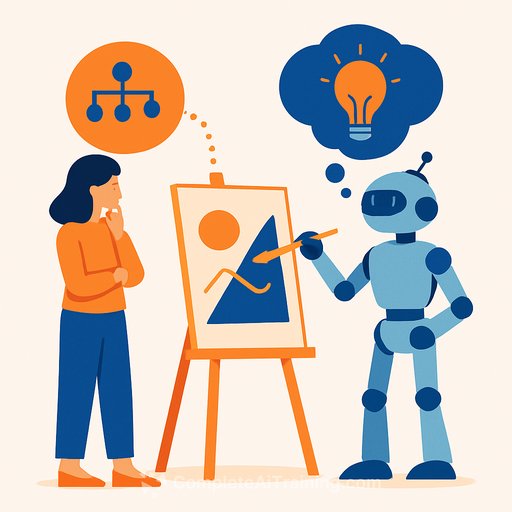
Imagine a drawing of a vase and a bowl of fruit appearing on a page—not drawn by a human hand but by a machine. How creative do you think that machine is? New research suggests that people’s judgment of AI creativity depends more on seeing the process behind the artwork than on the artwork itself.
Researchers from Aalto University and the University of Helsinki conducted studies to uncover what influences perceptions of AI creativity. Their key finding: the more of an AI’s creative process people observe, the more creative they rate its work.
Judging More Than Just the Final Product
In two experiments, 90 participants viewed drawings produced by two different robots—a sleek robotic arm and a mechanical plotter. The robots didn’t create original art but reproduced human-made sketches, ensuring consistent quality. This setup allowed the study to focus purely on human perception rather than the creativity of the robots.
Participants rated the creativity of the drawings in three stages: first, just the final image; second, watching videos of the drawing process without the robot visible; third, seeing the entire process including the robot physically drawing. Each time more of the process was revealed, creativity ratings increased.
"The more people saw, the more creative they judged it to be," explained the senior researcher. This approach is one of the first to separate and control the effects of product, process, and producer on creativity judgments, not just for AI but more broadly.
Robot Shape Doesn’t Influence Creativity Ratings
Previous studies hinted that people might find certain robot designs more artistic or advanced. However, this research found no significant difference in creativity ratings based on robot appearance. Despite the contrasting designs, participants rated both robots’ work similarly.
This suggests that the physical form of the robot doesn’t strongly affect perceived creativity, challenging some earlier assumptions. Instead, the creative process itself—what viewers get to see—plays a bigger role.
Implications for AI Design and Interaction
The findings reveal a bias: people tend to see something as more creative simply because they witness its creation. This insight is vital when designing AI tools that interact with users, especially as AI increasingly participates in physical creative acts.
It raises ethical questions, too. Should AI be designed to emphasize its creative process to appear more inventive, even if it isn’t? While this might boost engagement, it risks misleading users about the AI’s actual capabilities.
A Question Persisting for Over 40 Years
Machine creativity has been a focus of research for more than four decades. Early computational creativity efforts aimed to produce new ideas, art, or music through algorithms. Recently, machine learning models like transformers and diffusion systems have enabled AI to generate art, literature, and video on a large scale.
People react emotionally to AI-generated content and often attribute human-like intentions to it. As artists increasingly use AI tools, questions arise: How will AI change artistic creation? Will audiences accept AI-made works as truly creative? Exploring these questions begins with understanding how creativity in machines is perceived.
Looking Ahead: Open Questions
While revealing more of the creative process boosts perceived creativity, the study also pointed to other factors like robot likeability and users’ prior AI experience as potential influences. These areas require further research.
The research team plans to examine if these findings hold true across other creative domains such as music and dance. They also aim to explore how individual differences—like familiarity with robots or artistic background—affect creativity judgments.
By using open science methods and sharing their data, the researchers encourage others to build on their work. As AI tools become more embedded in everyday life, understanding how design influences perception will be key to building trust and making fair assessments of machine creativity.
For those interested in deepening their knowledge about AI and creativity, exploring relevant courses and resources can provide practical insights. Visit Complete AI Training's latest AI courses for more.
Your membership also unlocks: