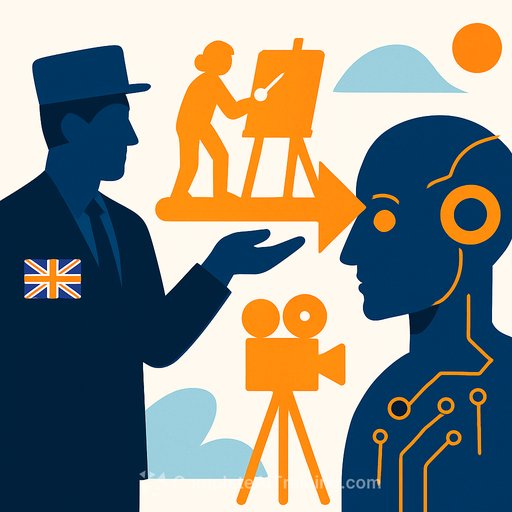
AI vs Creative Industries: The UK Government’s Risky Gamble
The UK government is cozying up to Big Tech instead of fiercely defending the creative industries against AI giants eager to exploit their work without fair compensation. This is a critical moment for a sector often called the “UK crown jewels,” which contributed £125bn, or 5.7%, to the UK economy in 2022.
While the UK considers consultations on AI, privacy, and copyright, it seems to be following the US’s lead by prioritizing the interests of tech conglomerates over those of artists and creatives. This choice threatens the livelihoods of actors, musicians, filmmakers, and content creators by allowing their work to be used freely to train AI models—a practice that is effectively theft, not “training.”
Why This Approach Is a Mistake
The core issue boils down to economics. The UK’s hope to “win the global race” in AI technology is unrealistic. The financial muscle required to build and train cutting-edge AI models is staggering, and the UK’s current commitments pale in comparison to US tech giants.
Chilling Economic Realities
The UK government’s AI Opportunities Action Plan includes a statement that AI will be “mainlined into the veins of this enterprising nation.” Yet, trade bodies highlight significant gaps like semiconductor supply planning, which is essential for large-scale AI development.
To put this in perspective, Microsoft spent over $55bn in the fiscal year 2024 on infrastructure alone. Google and Meta plan to spend $50bn and $40bn respectively on datacentre expansions. Meanwhile, Meta is negotiating a $15bn stake in Scale AI and offering individual salaries up to $75m for AI talent.
Training current AI models costs in the range of $100m, with future models expected to cost between $1bn and $10bn. Such financial demands make it nearly impossible for the UK government or its institutions to compete directly.
Deep Pockets Keep Big Tech on Top
- UK universities struggle as AI research shifts heavily toward industry, with US PhD graduates increasingly going to corporations.
- The US House Committee is pushing a decade-long moratorium on state AI regulation, while the UK government grants Big Tech unprecedented access to policymakers.
- Political rhetoric echoes tech industry mantras like “move fast and break things,” ignoring the needs of the creative sector.
Creative industries need government support that protects their work and livelihoods. The BFI report AI, copyright and productivity in the creative industries warns that without strong regulation, generative AI will worsen existing economic challenges for British creatives. The report calls for “purposeful, responsible and informed regulation” to safeguard these industries.
Legal Battles and Broken Promises
The Data (Use and Access) Bill, meant to protect creative copyright, is stuck in parliamentary ping-pong after multiple defeats in the House of Lords. The government appears to favor tech companies’ interests over those of the creative sector, risking irreversible damage in a race the UK cannot win.
Artists in the US face similar struggles, with tech CEOs enjoying far greater political access and influence than creators. The contrast is stark: while OpenAI’s CEO dines with lawmakers, artists rely on modest events to make their voices heard.
The Industry’s Alarm Bells
The chief executive of UK Music warns the government is “on the brink” of sacrificing the country’s music industry to please American tech giants. Channel 4’s CEO highlights the creative sector’s significant economic contribution and warns that unchecked use of data by AI models puts the industry at serious risk.
The government must stand up for the vulnerable rather than the powerful. Selling out the UK’s cultural industries to Silicon Valley is a form of colonization, with predictable consequences.
The Legal Reality Ignored
Despite claims that intellectual property uncertainty is hindering innovation, UK copyright law clearly prohibits text and data mining for commercial purposes without a license. The government’s reluctance to enforce existing laws appears to be a calculated move to gain favor with Big Tech—at the expense of the creative sector.
Protecting creative rights is not optional—it’s essential for sustaining an industry that fuels the UK economy and culture. The government’s role should be to defend these creators, not enable their theft.
Your membership also unlocks: