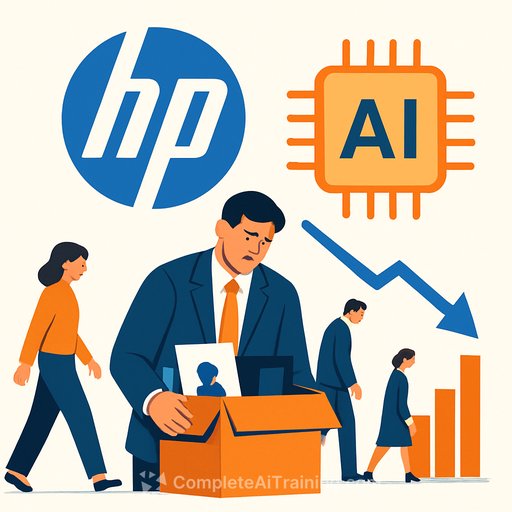
HP to cut up to 6,000 jobs by 2028 as it leans into AI: what product teams should do now
HP plans to reduce its workforce by 4,000 to 6,000 roles by October 2028 as it embeds AI across product development, operations, and customer support. The company expects $1bn in annual savings by 2028, with an estimated $650m in restructuring costs.
The move comes alongside a softer profit outlook for the year ahead and a clear signal: product cycles will be compressed, customer expectations will rise, and fewer people will be asked to ship more value.
Where the cuts will hit
Teams in product development, internal operations, and customer support are in scope. That points to AI being used to accelerate design, coding, testing, documentation, and post-launch support - not just back-office work.
If you lead a product org, assume your delivery model will be judged on speed, quality, and measurable customer outcomes with AI in the loop.
Why now: AI demand meets rising component costs
Cloud providers are buying large volumes of memory to power advanced AI models from firms like Anthropic and OpenAI. That surge has pushed up prices for DRAM and NAND, with analysts warning of margin pressure for PC makers.
HP noted memory is 15%-18% of a typical PC bill of materials, and price increases have accelerated in recent weeks. Translation: expect tighter cost controls, sharper SKU decisions, and more pressure to ship AI features that customers actually use.
Quarter snapshot
HP reported $14.6bn in Q4 revenue, above expectations. AI-enabled PCs represented more than 30% of shipments in the quarter to 31 October.
Guidance for the coming year is $2.90-$3.20 adjusted EPS versus analyst expectations of $3.33, partly due to US trade tariffs. Shares fell as much as 6% after the cuts were announced.
The broader labor signal
The National Foundation for Educational Research warned up to 3m low-skilled UK jobs could disappear by 2035 due to automation and AI, with trades, machine operations, and administrative roles most exposed. In the US, analysis from McKinsey suggests about 40% of jobs could be replaced by AI, with more than half of work hours automatable using current tech and up to $2.9tn in value by 2030.
Implications for product development leaders
Your mandate is clear: deliver faster, raise customer satisfaction, and make AI an everyday part of the product lifecycle. Here's how to respond with focus instead of panic.
Move 1: Map work to automation - task by task
- Backlog grooming, requirements, and spec drafting with AI assistants.
- Design variants, UX copy, and localization generated and A/B tested.
- Code scaffolding, unit tests, and refactors via code copilots.
- Automated test generation, flaky test detection, and CI triage.
- Release notes, docs, and API examples produced from code/comments.
Move 2: Stand up a lean AI toolkit
- Code copilot, secure chat with retrieval over your product knowledge base, and an evaluation harness for prompts and models.
- Guardrails for PII handling, content filters, and human-in-the-loop approvals for customer-facing outputs.
Move 3: Close the data loop
- Instrument product telemetry by default. Capture prompts, outcomes, latency, and user satisfaction.
- Build a feedback pipeline from support interactions back into backlog prioritization and model fine-tuning.
Move 4: Upskill and redeploy
- Train PMs, designers, and engineers on prompt patterns, AI evaluation, and LLMOps basics.
- Set expectations for measurable gains: cycle time, defect rates, support deflection, and activation of AI features.
If you need structured paths for teams, explore focused training and certifications for AI-in-product roles: Courses by job and Latest AI courses.
Move 5: Get ahead of cost and platform choices
- Model on-device vs. cloud inference by feature: latency, cost per monthly active user, and data sensitivity.
- Plan for memory price volatility; design SKU options and feature flags that let you adapt without rework.
Move 6: Governance that doesn't slow you down
- Policy for acceptable use, model/feature approvals, and incident response. Keep it one page per area to avoid stall-out.
- Document provenance for AI-generated artifacts in code and product specs.
A simple 90-day plan
- Weeks 1-2: Audit the product lifecycle. Pick three high-ROI use cases (e.g., test generation, agent-assist in support, spec drafting). Define success metrics.
- Weeks 3-6: Set up the stack (code copilot, retrieval, prompt/eval repo). Run security review and data controls.
- Weeks 7-10: Pilot with two teams. A/B test against baseline. Publish weekly metrics and lessons learned.
- Weeks 11-13: Scale what works, sunset what doesn't. Bake AI steps into your definition of done. Reforecast budget and hiring based on measured impact.
What to watch next
- DRAM/NAND pricing and server capacity - influences device costs and on-prem vs. cloud decisions.
- Tariff shifts that affect BoM and regional SKU strategy.
- Adoption of AI PCs and the actual usage of onboard AI features by customers.
- Vendor pricing for foundation models and tokens - keep alerts for changes that move your unit economics.
Bottom line: AI is becoming the default workflow. The teams that document, instrument, and iterate will ship better products with fewer resources - and have the data to prove it.
Your membership also unlocks: