AI scales railcar inspection: Huawei's TFDS moves from freight to passenger trains
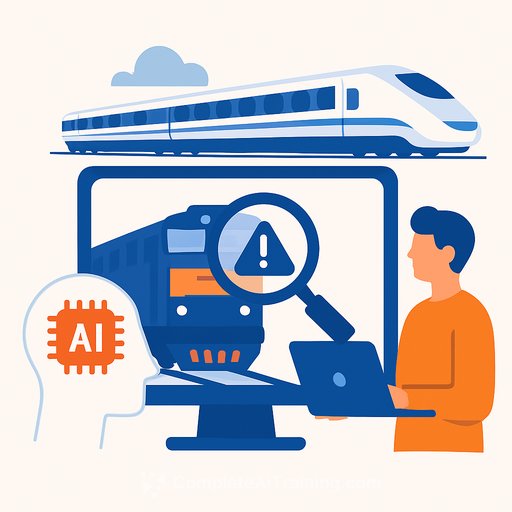
Huawei is pushing its TFDS (Trouble of Moving Freight Car Detection System) beyond freight wagons, aiming for automated inspection of an entire train's exterior - including passenger stock.
TFDS started in 2023 as a human-led image review tool. Trackside cameras capture high-definition images as trains pass detection stations, and inspectors review the frames to spot faults.
The scale problem
China runs close to one million freight trains, generating hundreds of millions of images per day. Around 6,000 inspectors review an average of 15,000 images each, every day.
That workload doesn't scale without automation. It also makes latency and consistency hard to control.
What changed: AI in the loop
Huawei integrated AI via its Pangu Railway Model to auto-flag faults for human validation. The model is pre-trained with billions of parameters and millions of samples, covering more than 70 classes of China Railway freight rolling stock and 430+ fault types.
Elastic compute capacity backs the system so detection stations can handle traffic spikes without queue blowups.
Accuracy and throughput
Huawei reports an overall fault identification rate near 99.3% across human-machine collaboration and pass-through scenarios, with no missed critical faults to date.
Inspection time per train dropped from about 15 minutes with 4-5 staff to 5-8 minutes with 1-2 staff validating AI outputs.
Where it works today - and what's next
Current coverage focuses on running gear and underframes. The roadmap targets comprehensive inspection of the entire exterior of a train car, bringing passenger fleets into scope.
How this likely works under the hood (for engineers)
- Acquisition: High-definition trackside cameras at detection stations capture frames as trains pass at speed.
- Ingestion: Stream/batch pipelines transport media to processing nodes; metadata (train ID, consist, timestamp, track) attaches early.
- Pre-processing: Frame selection, de-duplication, blur checks, motion compensation, geometric normalization, and lighting correction.
- Model serving: Multi-label detection/classification (70+ stock classes, 430+ fault types) with thresholds tuned for recall on safety-critical faults.
- Human-in-the-loop: AI flags cases; inspectors validate, correct labels, and approve actions. Feedback feeds continuous training.
- Elastic compute: Autoscaling GPU pools to absorb surges; priority queues for suspected critical faults to keep SLA tight.
- Observability: Drift, calibration, and false positive/negative rates monitored by line, region, and weather conditions.
- Safety ops: Rules engine for escalation paths, audit trails, and traceability from image to decision to maintenance ticket.
Practical implementation notes
- Edge first: Do lightweight screening at the station; ship only candidate frames upstream to save bandwidth.
- Latency budgets: Fix per-stage time targets (ingest, preprocess, infer, review). Alert on tail latency, not averages.
- Triage policy: Route high-severity classes to senior reviewers; auto-close trivial cases with multi-pass consensus.
- Model management: Version every model and dataset; run shadow/AB tests before promotion; keep a rollback path.
- Label quality: Use active learning and targeted relabeling for failure pockets (weather, night shots, dirty equipment).
- Compliance and risk: Document the pipeline and controls. For guidance, see the NIST AI Risk Management Framework here.
Why this matters for IT and dev teams
TFDS is a clear pattern for high-volume vision systems: push inference close to the edge, keep humans in the loop for safety, and scale compute elastically to match real-world traffic. The key work is less about the model and more about data flow, review workflows, and monitoring.
If you're building similar pipelines, a small, high-recall model at the edge plus a heavier validator upstream can cut costs while holding safety thresholds. Then feed reviewer corrections back into training on a fixed cadence.
Skills and next steps
Teams supporting systems like this need strengths in MLOps, streaming, GPU scheduling, and evaluation under distribution shift. If you're upskilling in AI automation, this AI automation certification can help structure learning and practice.
Your membership also unlocks: