Education + AI: Huawei's AIEC Solution Targets Scalable AI Learning in Schools
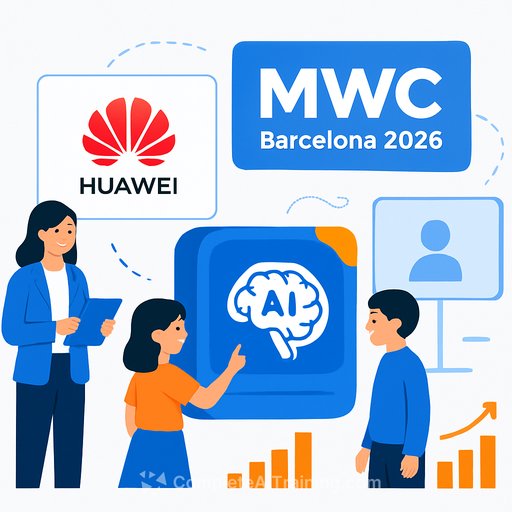
At MWC Barcelona 2026, Huawei introduced its AI Education Platform (AIEC) for basic education, built to make AI literacy accessible across primary and secondary schools. The focus is simple: lower the entry barrier and reach more students, faster.
Huawei positions itself as a technology enabler and ecosystem builder, working with customers and partners to deliver scenario-based solutions. The AIEC solution is the centerpiece of that strategy for schools.
What is the AIEC solution?
AIEC brings the pieces schools need to teach general AI at scale-without reinventing their tech stack or curriculum from scratch. It's designed for day-to-day classroom use, labs, and long-term skills development.
- Hardware computing infrastructure
- Model services (including open-source large models)
- Application platforms for teaching and projects
- AI teaching and laboratory management system
What students and teachers get
- Systematic general AI education resources for all ages in basic education
- 10+ hands-on AI practice projects to turn concepts into skills
- 50+ experimental tools and applications for classroom and lab use
- Structured lab management to keep classes organized and safe
The goal: build core competencies students will need for future work and citizenship, while supporting national innovation and industry upgrades.
Where it's already running
In Zhejiang Province, China, Huawei and partners (including CourseGrading) have deployed a general AI education platform across 500+ primary and secondary schools. The rollout combines computing power, open-source models, and classroom-ready projects and tools, with plans to reach one million students.
Global demonstration with Pui Kiu Middle School
Huawei also launched a global demonstration project with Pui Kiu Middle School, showcasing real classroom applications of AI in secondary education. The aim is to provide practical, replicable models schools can adapt during digital transformation.
Why this matters to education leaders
- Access: "The lowest threshold and the widest coverage" keeps equity front and center.
- Whole-school approach: Infrastructure, content, and lab management work together.
- Scale through partnerships: Co-delivery with local partners supports faster adoption.
- Alignment potential: Schools can map AIEC learning to recognized AI literacy guidance, such as the UNESCO guidance on AI in education.
Practical next steps for your school or district
- Define outcomes: Map AI literacy goals by grade band (ethics, data basics, modeling, evaluation, and classroom use).
- Check readiness: Inventory devices, connectivity, and lab environments; plan for safe, monitored access to AI tools.
- Upskill staff: Start with a small cohort of teacher leaders, then cascade. Try the AI Learning Path for Teachers for practical integration.
- Pilot smart: Run short pilots (6-10 weeks) using the 10+ projects and 50+ tools; gather evidence, then scale.
- Governance: Set clear policies on data privacy, student safety, model usage, and assessment integrity.
- Measure what matters: Track student skills, teacher workload, and cost-per-learner to guide expansion.
Huawei's AIEC solution signals a push toward accessible, scalable AI education. If you're planning for next year, start small, prove value, and expand with a clear governance and training plan. The schools that treat AI as a core literacy-taught safely and practically-will give every student a fair shot at the future.
Your membership also unlocks: