Judicious AI Can Strengthen India's Healthcare: Key Takeaways for Clinical and Pharma Leaders
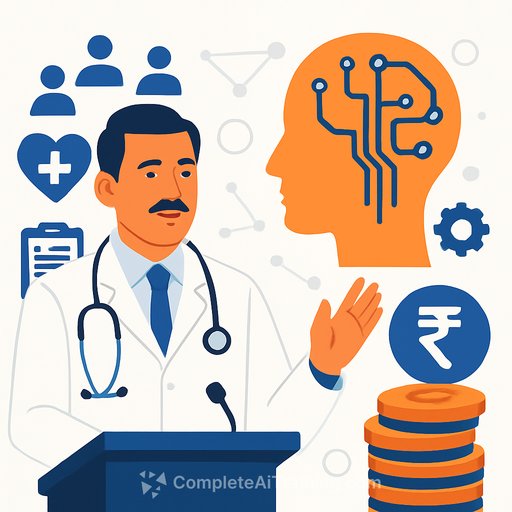
At the CII Pharma & Life Sciences Summit 2025, Union Minister Dr. Jitendra Singh outlined a clear message: careful, responsible use of AI can meaningfully improve diagnostics, drug discovery, and care delivery across India. The direction is collaborative-government and industry working as one system to build solutions that scale.
The emphasis was simple but non-negotiable: keep technology human-centric. Use AI in a hybrid model that speeds up care while protecting human judgment and empathy at the bedside.
What this means for your teams
AI isn't a future bet anymore; it's a present-day operational tool. From minutes-long diagnostics to language-inclusive telemedicine, systems are moving from pilot to production where guardrails are clear and value is measurable.
- Diagnostics: AI tools are trimming testing and interpretation times from days to minutes. This frees up specialists and accelerates treatment decisions.
- Telemedicine: AI-supported consultations in local languages reduce friction for rural and underserved communities, improving adherence and follow-ups.
- Workflows: Triage, coding, discharge summaries, and prior auth can be streamlined without adding cognitive load to clinicians.
India's biotech momentum
There's a growing base in biotechnology, gene therapy, and vaccines, supported by public-private programs. Current initiatives include synthetic antibiotics, DNA and HPV vaccines, and bio-manufacturing technologies led by the Department of Biotechnology.
India is also shifting from importing curative care to exporting preventive care-vaccines, biosimilars, and affordable medical devices. For hospitals and pharma, this opens new clinical pathways and market opportunities.
Funding and collaboration are opening up
A ₹1 lakh crore R&D fund has been announced to directly finance deep-tech research, including health and agriculture. For industry leaders, this signals a move toward outcome-based collaborations with faster routes from lab to bedside.
The model is "whole-of-government" and "whole-of-industry." If you're building, validating, or scaling AI-enabled solutions, this is the moment to formalize partnerships and standardize data-sharing frameworks.
How to integrate AI without losing the human core
- Start with use cases that pay back fast: radiology workflow, sepsis alerts, dermatology triage, antibiotic stewardship, and claim automation.
- Set clinical and operational guardrails: define decision rights, escalation paths, and documentation rules for AI-assisted recommendations.
- Bake in language access: deploy models that support local languages inside telemedicine and patient education. Consider eSanjeevani-integrated workflows where relevant.
- Govern data from day one: consent, de-identification, audit trails, and retention policies. Avoid model drift with continuous monitoring.
- Bias and safety checks: run pre-deployment validation on local datasets; monitor false positives/negatives by demographic group.
- EHR and LIS integration: prioritize standards (HL7 FHIR, DICOM) and reduce duplicate clicks; clinicians won't use tools that slow them down.
- Procurement discipline: require clinical validation, model update schedules, uptime SLAs, cybersecurity posture, and a clear ROI timeline.
- Train the workforce: short courses for clinicians, power users in departments, and super-admins who manage policies and permissions.
Metrics that actually matter
- Turnaround time per modality or test panel
- Admission-to-antibiotic timing and guideline adherence
- Readmission rate and length of stay by diagnosis-related group
- Claim denial rate and days in A/R
- Teleconsult completion rate and follow-up adherence
- Clinician time reclaimed per shift and burnout indicators
Where to focus in the next 90 days
- Pick two high-velocity pilots: one clinical (e.g., imaging triage) and one operational (e.g., discharge summaries).
- Set a lightweight AI oversight committee with clinical, quality, IT/security, and legal.
- Lock data-sharing and validation plans with at least one industry or academic partner.
- Publish a plain-language policy for AI use that patients and staff can understand.
The bigger picture
India's healthcare ecosystem is moving in sync-policy, funding, and industry capacity are aligning. The opportunity is to build AI that speeds care, lowers cost, and keeps empathy intact.
Leaders who pair clinical rigor with disciplined deployment will set the standard. Those who treat AI as a team sport-government, industry, and providers-will move fastest.
Upskill your teams
If you're building internal capability across roles, explore practical training paths here:
Your membership also unlocks: