Palladyne AI's Defense Tech: Edge Autonomy With Humans in the Loop
Palladyne AI has launched a defense division and doubled down on a clear stance: keep humans in control. The company says operators can supervise, interrupt, and redirect its AI at any time-no black box, no hands-off automation.
The new arm, Palladyne Defense, blends Palladyne's autonomy software with precision hardware from GuideTech LLC, Warnke Precision Machining, and MKR Fabricators. The goal is simple: purpose-built systems where software and hardware evolve together.
Why the hardware + software stack matters
Third-party drones work, but you cap potential when the platform isn't designed for your AI. Palladyne is moving to tightly integrated systems-similar to how the top device makers build for their own software from day one.
For IT and engineering teams, this is a familiar pattern: fewer integration gaps, more predictable latency, and clearer accountability across the stack.
SwarmOS: Collaborative autonomy at the edge
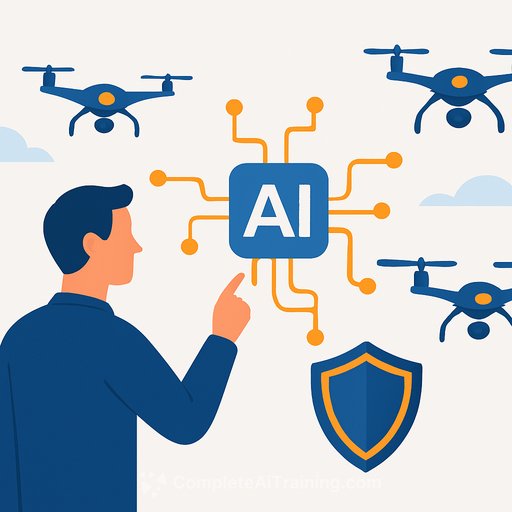
Palladyne's SwarmOS is the defense variant of Palladyne Pilot. One operator can run multiple missions with drone swarms, sensors, and autonomous defense systems acting as a coordinated team across air, land, and sea.
Information is curated and shared peer-to-peer, then acted on in real time. The system integrates with native autopilots and can autonomously manage point-tilt-and-zoom (PTZ) cameras, lowering cognitive load so a single operator can manage more assets with fewer clicks.
How the AI "thinks"
The company trains agents to focus on what matters for the task and disregard noise. That selective attention mirrors how people naturally filter signals-most inputs are ignored unless they're relevant to the mission.
In practical terms, this means less wasted compute, faster decisions, and clearer operator oversight when it counts.
Edge-first by default
Palladyne deploys AI at the edge. Drones reason and adapt locally without cloud dependency, keeping operations live under comms constraints and cutting latency where every second matters.
For distributed systems folks, think local inference, intermittent connectivity, and graceful degradation-baked into the architecture, not bolted on.
Aligned with DoD priorities
The company says Palladyne Defense is built to support Department of Defense goals for cross-domain, multi-platform collaboration and collaborative autonomy. If you're tracking initiatives like JADC2, this direction will feel familiar.
Project Banshee: One-to-many control for loitering munitions
Palladyne is also developing Project Banshee-next-gen autonomous loitering munitions integrated with SwarmOS. The key shift: moving from one-operator-one-drone to one-operator-many.
The company positions this as a cost-per-effect win with precision harm mitigation, pushing for higher control, higher accountability, and lower operator burden.
Key technical notes for builders
- Human-in-the-loop by design: operators can supervise, interrupt, and redirect autonomy in real time.
- Edge inference: on-device reasoning keeps systems responsive under degraded comms and reduces cloud costs.
- Selective attention: models prioritize mission-relevant signals and drop noise to accelerate decision cycles.
- Collaborative swarming: peer-to-peer information sharing and coordinated tasking across heterogeneous assets.
- Native autopilot integration: autonomous control of flight plans and point-tilt-and-zoom cameras to reduce cognitive load.
- Cross-domain operations: air, land, sea compatibility for mixed teams of autonomous systems.
- Hardware/software co-design: purpose-built platforms to minimize integration bottlenecks and latency.
Why this matters for IT and development teams
Defense autonomy is moving toward accountable AI: interpretable behavior, tight feedback loops, and ops-ready edge deployments. The lesson extends beyond defense-any mission-critical system benefits from HITL controls, curated data pipelines, and decentralized coordination.
If you're building for autonomy, swarm coordination, or edge AI, invest in skills around multi-agent systems, on-device optimization, and operator UX. That's where the leverage is.
Level up your edge + autonomy stack
Want to go deeper into AI for edge systems, multi-agent coordination, and practical deployment patterns? Explore focused training paths here:
Courses by skill: edge AI, agents, and deployment
Your membership also unlocks: