Humans& raises $480M seed at $4.48B valuation - what finance teams should read into it
Humans&, an AI startup founded by researchers from OpenAI, Anthropic, Google DeepMind, and Meta, closed a $480 million seed round at a $4.48 billion valuation. That's late-stage pricing at day zero - a clear signal that capital is concentrating around labs with top-tier pedigree and access to compute. For more on the broader pattern of talent and capital clustering in elite labs, see our Research coverage.
The round was led by Ron Conway's SV Angel and co-founder Georges Harik. Nvidia, Jeff Bezos, and GV (Alphabet's venture arm) participated, underscoring the pull of high-signal AI founders and the compute supply chain.
At a glance
- Round: $480M seed, valuing the company at $4.48B
- Leads: SV Angel and Georges Harik
- Participants: Nvidia, Jeff Bezos, GV, and other VCs
- Product: Human-centric AI for communication and collaboration; first launch expected early this year
- CEO quote: "The model will coordinate with people, and other AIs where appropriate, in order to allow people to do more and to bring them together." - Eric Zelikman
Why this seed size matters
Checks of this size at seed compress the timeline: recruiting, compute commitments, and go-to-market will move in parallel. It also raises the bar on milestones; investors backing this round will expect meaningful product traction or clear technical differentiation within months, not years.
Nvidia's participation is strategically aligned. As demand for GPUs spikes, equity positions can secure long-term partnerships and preferred access to hardware. For finance teams, that reduces a key execution risk for any AI lab dependent on large-scale training and inference capacity.
Nvidia and SV Angel involvement also sends a simple message to the market: compute + elite talent still clears in any rate environment.
Product thesis
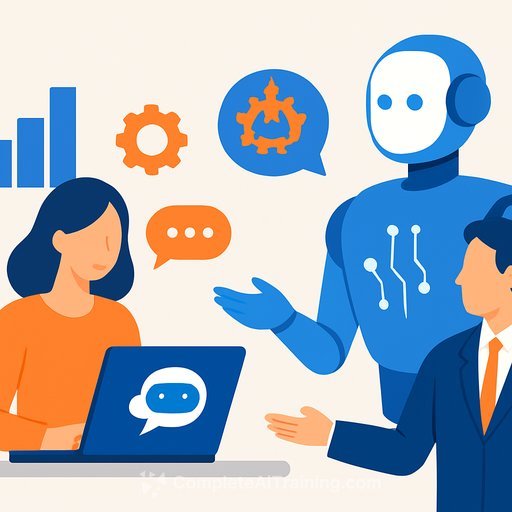
Humans& is building AI that coordinates work across people and other AIs. In practice, expect orchestration inside common communication flows - think meeting threads, documents, tickets, messages - rather than standalone chatbots.
If the tool meaningfully shortens decision loops and limits cross-tool thrash, enterprise adoption can come from bottom-up usage with executive-level expansion. The launch window "early this year" means near-term product and revenue signals.
Team signal
- Georges Harik: early Google leader involved in Gmail, initiated Google Docs, and led the Android acquisition - strong product and acquisition DNA.
- Eric Zelikman: previously at xAI, contributed to training data for Grok-2; research includes reasoning-focused reinforcement learning.
- Founding bench: veterans from OpenAI, Anthropic, Google DeepMind, and Meta.
What finance leaders should track next
- Compute access and cost curve: Supply agreements, GPU allocation, and cost per token/seat. Watch gross margin paths tied to inference optimization.
- Security and compliance: Data handling inside enterprise comms. SOC2/ISO progress and customer requirements for auditability.
- Go-to-market motion: Bottom-up adoption vs. enterprise sales, price packaging (seat vs. usage), and expansion triggers.
- Differentiation: Coordination quality across tools and teams, not just model scores. Look for measurable workflow compression.
- Ecosystem position: Partnerships with incumbents and stack providers; depth of integrations that drive stickiness.
Why the valuation can still pencil
If Humans& becomes embedded in daily communication and decision flows, net revenue retention and low churn follow. The spend can justify itself through cycle-time reduction and fewer context switches - metrics CFOs can measure.
The flip side: competition is intense, switching costs are not yet fixed, and many labs are targeting similar coordination problems. Early proof points should show active seats, usage concentration within departments, and a path to margin improvement as inference scales.
Bottom line
This is a concentrated bet on a veteran team, early access to compute, and a clear wedge into enterprise collaboration. For finance teams, treat this as a near-term signal to revisit AI line items: budget for pilots, insist on security reviews, and anchor ROI to time-to-decision and error-rate reductions.
If you're mapping practical tools for your org, here's a curated overview of options built for finance teams: AI tools for Finance.
Your membership also unlocks: