
AI news ·
Humans still matter more than AI in finance
Financial professionals still drive major decisions in banking and investment management, with AI handling data processing and pattern detection as a support layer. Firms are augmenting staff, not replacing them.
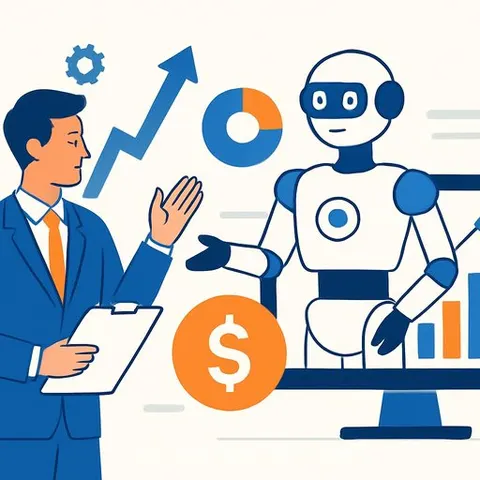
Humans Still Matter More Than AI in Finance
Financial professionals remain the primary decision-makers in their field, even as artificial intelligence tools proliferate across banking, investment management, and corporate finance. The technology serves as a supporting layer-useful for processing data and flagging patterns-but human judgment continues to drive major financial decisions.
This reality contradicts much of the breathless coverage around AI adoption in financial services. Banks and asset managers have invested heavily in machine learning systems, yet they still rely on experienced professionals to interpret results, assess risk, and make calls that affect millions of dollars.
The distinction matters for anyone working in finance. Understanding where AI genuinely adds value-and where it reaches its limits-helps professionals use these tools effectively rather than deferring to them blindly.
Where AI Performs Well
Artificial intelligence excels at specific, bounded tasks. It processes market data faster than humans. It identifies anomalies in transaction patterns. It surfaces relationships between variables that might take a person hours to spot manually.
These capabilities free up financial professionals to focus on work that requires judgment. A portfolio manager can spend less time on routine analysis and more time on the strategic thinking that clients actually pay for.
Where Human Expertise Remains Essential
Complex financial decisions involve unknowns that no algorithm can fully account for. Market conditions shift. Regulatory environments change. Companies pivot their strategies. Geopolitical events create cascading effects across asset classes.
A seasoned investment professional draws on years of pattern recognition, relationships with market participants, and intuition built through lived experience. These elements don't fit neatly into training data.
Risk assessment-arguably the core function of finance-requires judgment about tail events and edge cases. AI systems trained on historical data struggle with scenarios that fall outside their training set. The 2008 financial crisis, the COVID-19 market shock, and sudden liquidity crises all caught many models flat-footed.
The Practical Reality
Finance firms are not replacing teams with algorithms. Instead, they're using AI to augment existing staff. An analyst gets better at their job when a system handles the mechanical parts of research. A credit officer makes faster, more consistent decisions when AI pre-screens applications and flags risk factors.
The professionals who thrive in this environment understand both the capabilities and constraints of the technology. They know which decisions can be partially automated and which require human oversight. They use AI as a tool, not a substitute for thinking.
For finance professionals looking to build this competency, learning how AI works in financial contexts-not just theoretically, but in practice-is increasingly important. Resources like AI for Finance and the AI Learning Path for CFOs offer practical grounding in how these systems actually function in financial decision-making.
The finance industry will continue adopting AI tools. The professionals who understand how to work alongside them-rather than compete with them or blindly trust them-will remain the most valuable in the field.