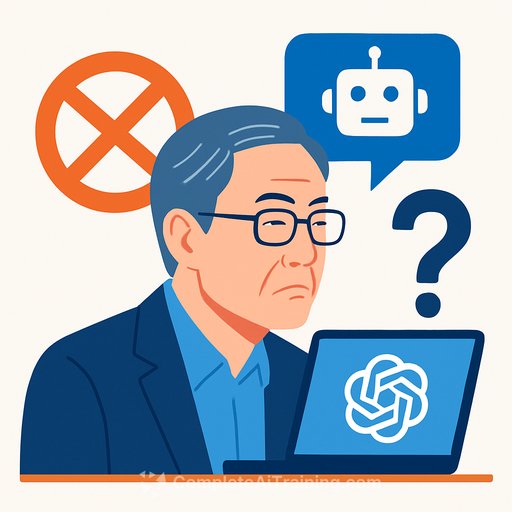
Writers, AI, and the New Line in the Sand
Novelist Hwang Sok-yong recently said he used ChatGPT as an assistant while writing Halmae. He fed the model a handful of elements-like a 600-year-old zelkova, historical context, and structural choices-and used the back-and-forth to build the "underlying framework" of his novel.
That's the reality: established authors are experimenting in the open. Meanwhile, many contests and publishers are tightening rules and banning AI outright.
The Tension: Openness vs. Prohibition
Some literary awards now state that any AI-generated text will disqualify a submission or void a prize. A recent contest entry even raised suspicion after including "**" marks-an artifact sometimes seen in AI outputs.
The issue: rules are getting stricter, but enforcement tools don't exist. Editors admit they rely on gut checks and author honesty.
Reality Check: AI Detection Isn't There Yet
There's no reliable, industry-standard method to confirm AI use in fiction. Even tools built to flag AI text are inconsistent and prone to false positives. OpenAI itself acknowledged low accuracy for its prior classifier and discontinued it.
OpenAI: Statement on AI text detection accuracy
Privacy is another block. Publishers don't want to upload unpublished manuscripts to third-party platforms. Some authors now add clauses forbidding AI-based proofreading or editing. That leaves verification in limbo. For methods and evaluations related to detection and assessment, see AI Research resources.
What This Means for Your Work
If you write for a living, assume two truths: bans are rising, and detection is unreliable. The smart move is to set clear boundaries, document your process, and control your IP.
A Practical Playbook for Writers
- Define AI's job upfront. Acceptable: research pointers, idea generation, outlining options, style checks. Off-limits (if rules require): drafting narrative passages or dialogue you present as your own.
- Keep a process log. Save prompts, timestamps, and which parts of your draft were AI-assisted. If you're audited, you have a paper trail.
- Version everything. Use version history in Google Docs or a simple Git repo so you can show how a draft evolved.
- Protect your manuscript. Don't paste full chapters into public tools if you're under NDA or worried about rights. Summarize sections or use local/offline tooling for sensitive text.
- Use plagiarism checks, not AI detectors. Plagiarism tools can still catch derivative overlap. AI detectors can't reliably prove anything.
- Add provenance notes. If permitted, include a brief "AI collaboration" disclosure with scope (e.g., outline help, grammar polish). Keep it factual and specific.
- Clarify contracts. Add language on what you will and won't use AI for, and how your data is handled.
Sample Contract/Disclosure Language
- Contract clause: "Author will not use generative AI to produce narrative prose or dialogue in the Work. AI may be used for research, outlining, or copyediting. No third-party tool will store unpublished manuscript text beyond session scope."
- Submission note (if allowed): "AI was used for outline exploration and grammar checking. All narrative prose and dialogue were written and revised by the author."
Submitting to Contests or Publishers with AI Restrictions
- Read the fine print. Some ban any AI involvement; others allow research or copyediting.
- Match your process to their rules. If they prohibit AI outright, don't use it-even for brainstorming.
- Prepare a process summary. If questioned, you can show your workflow and drafts.
- Avoid suspicious artifacts. Remove placeholder symbols, boilerplate, or unnatural phrasing before submission.
Should We Create an "AI Collaboration" Track?
There's a growing push to label and separate categories: pure human text vs. AI-assisted. That transparency could lower the temperature and let readers choose what they want to support.
Until standards are set, expect a hybrid world: some venues allow collaboration with clear labels, others prohibit it to protect their brand of originality.
Ethics and Reader Trust
Disclosure builds trust. If you used AI, say how. If you didn't, say so plainly. Readers care less about tools and more about intent, craft, and accountability.
For broader guidance on authors' rights and AI, see The Authors Guild's AI resources.
If You Choose to Skill Up
Want structured training on prompt craft, workflows, and tool safety for working writers? Explore curated options here: AI courses by job.
Bottom Line
AI can help you think, but it shouldn't replace your voice-especially where rules forbid it. Set your boundaries, document your process, and protect your rights. That's how you ship work you can stand behind, no asterisks needed.
Your membership also unlocks: