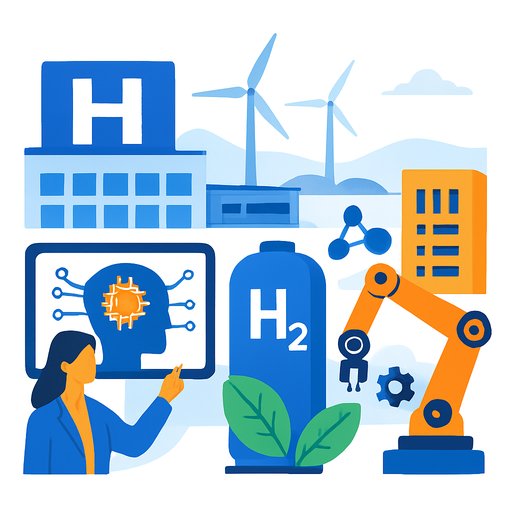
Hyundai Motor Group to invest 10 trillion KRW in Saemangeum for AI, hydrogen, and robotics
Hyundai Motor Group will invest about 10 trillion Korean won over five years to build an AI data center, hydrogen production facilities, and a robotics plant in the Saemangeum area of Jeollabuk-do. An MOU with the Ministry of Trade, Industry and Resources, the Ministry of Climate, Energy and Environment, and related agencies is expected in Saemangeum as early as this week. Key figures from government and the group, including Chairman Chung Eui-sun and Vice Chairman Chang Jae-hoon, are slated to attend.
The plan applies a "local production for local consumption" model: renewable energy generated in Saemangeum will directly support AI, hydrogen, and robotics operations. With vast land-about 409 square kilometers, roughly 140 times Yeouido-and strong solar potential, the site is suited for large-scale power generation and industrial build-out. Local economic revitalization and new employment in Jeollabuk-do are central outcomes.
What this means for government
This is the first concrete project under the group's announced 125 trillion KRW domestic investment starting in 2026. Beyond autos, the plan advances national goals in AI infrastructure, clean energy, and advanced manufacturing. Government roles now shift from announcement to execution: land, grid, permits, workforce, safety, and transparent governance.
- Set a single, published permitting timeline (data center, renewable, hydrogen, robotics), with a one-stop approvals office in Saemangeum.
- Secure grid capacity and fast-track substations, interconnection, and curtailment rules; enable corporate and virtual PPAs to match 24/7 load for the AI center.
- Accelerate utility-scale solar on reclaimed land; define REC/green premium pathways so "local production, local consumption" is bankable.
- Finalize hydrogen safety codes, siting, and transport (trailers, pipelines, refueling) with drills and incident response protocols.
- Plan water sourcing and treatment for electrolysis and data center cooling; address desalination needs and brine management.
- Set data center efficiency targets (PUE/WUE) and cybersecurity standards; align with national AI infrastructure policy.
- Stand up talent pipelines with local universities and TVET programs; fund scholarships and mid-career upskilling for AI, electrolyzers, and robotics.
- Require SME participation and local procurement quotas with fair-pay terms and fast invoice cycles.
- Publish quarterly dashboards on progress, jobs, emissions, and renewable buildout to sustain public trust.
The three pillars: AI, hydrogen, robotics
AI: The largest share goes to an AI data center in Saemangeum. Following last year's "Kkanbu meeting," Chairman Chung Eui-sun, NVIDIA CEO Jensen Huang, and Samsung Electronics Chairman Lee Jae-yong agreed to introduce 50,000 NVIDIA Blackwell GPUs-positioning the center to accelerate autonomous driving and robotics development.
Hydrogen: The group is testing water electrolysis in Saemangeum, aiming to pair it with new solar capacity for green hydrogen production. This avoids fossil-based inputs common in conventional electrolysis and supports domestic clean fuel supply for transport and industry. For context on electrolytic hydrogen, see the IEA's overview of the hydrogen value chain: IEA: Hydrogen.
Robotics: Hyundai Motor Group plans a multi-billion-won robot factory at Saemangeum. While models are not finalized, candidates include the Mobed mobile platform and wearable robots for factory workers. The group also plans to pilot advanced smart mobility, which can help mature autonomous driving through real-world trials and regulatory sandboxes.
Integration with Jeonju: a hydrogen-commercial vehicle hub
Hyundai Motor's Jeonju plant in Wanju County, which produces hydrogen buses and trucks, is expected to expand its role. Linking Saemangeum's green hydrogen hub with Jeonju's vehicle production can lower fuel logistics costs and speed fleet deployment. Government support for depot refueling, public procurement of hydrogen buses, and standardized contracts will be key.
Site advantages and regional context
Saemangeum's scale and sunlight give it an edge for renewables and large-footprint facilities. For background on the district and ongoing development, see the official Saemangeum Authority: Saemangeum.
The group has evaluated southwestern locations outside established hubs like Ulsan and Gwangju. Government insiders also cite benefits from recent Korea-U.S. tariff discussions that reportedly lowered certain auto tariffs from 25% to 15%, improving business conditions.
KPIs to lock into the MOU
- Jobs: direct, indirect, and induced (with targets for local hires and SMEs).
- Energy: percent of AI load covered by local renewables and hourly-matched clean energy.
- Hydrogen: annual green H2 output (tons), cost trajectory, and refueling sites commissioned.
- Data center: PUE/WUE thresholds and uptime SLAs aligned with grid constraints.
- Robotics: factory capacity (units/year) and adoption milestones in public services.
- Education: number of trained workers and certifications issued per year.
- Timeline: critical path milestones with variance reporting and recovery plans.
Risk watchlist and mitigations
- Grid and renewable delays: stage-gated PPAs, transformer/equipment early orders, and curtailment compensation rules.
- Water and environment: desalination capacity, brine dispersion modeling, and continuous marine monitoring.
- Supply chain: long-lead items (electrolyzers, GPUs, switchgear) with dual sourcing and bonded inventory.
- Community acceptance: local hiring guarantees, impact funds, and transparent air/noise/traffic reporting.
- Hydrogen safety: third-party audits, sensor networks, and emergency response MOUs with local services.
Immediate next steps for public agencies
- Finalize the MOU annexes with clear KPIs, dispute resolution, and data-sharing clauses.
- Stand up a joint PMO with weekly engineering reviews and monthly public updates.
- Publish the permitting and grid interconnection playbook for Saemangeum within 30 days.
- Launch workforce programs aligned to AI ops, electrolyzer tech, and robotics maintenance.
- Prepare procurement frameworks for hydrogen buses and municipal fleets to anchor early demand.
For officials coordinating AI infrastructure, governance, and public-private collaboration, this resource may help: AI for Government.
Your membership also unlocks: