AI-Augmented NDT: IAEA Launches Five-Year Project to Improve Disaster Response
27 January 2026
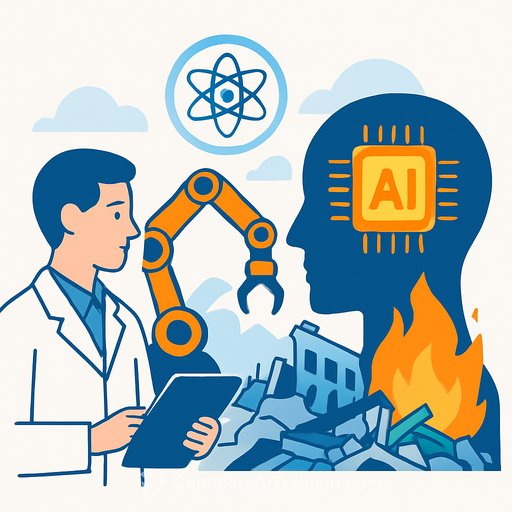
The IAEA has launched a five-year Coordinated Research Project to integrate artificial intelligence with non-destructive testing for disaster response. The goal: faster, safer and more consistent structural assessments when bridges, buildings or dams are at risk after earthquakes, floods, tsunamis, extreme weather or industrial accidents.
This matters for engineers on the ground and the IT teams who enable them. Real-time, AI-assisted NDT can shorten assessment cycles, reduce exposure to unsafe sites and guide smarter recovery decisions under pressure.
Why this matters for IT and development teams
AI-enhanced NDT turns sensor data-ultrasonics, radiography, imagery, thermal and tomographic streams-into actionable signals. That requires clean data pipelines, clear standards, and models that run reliably at the edge and in low-connectivity environments. For practical guidance on building robust pipelines, model evaluation and deployment workflows, see the AI Learning Path for Data Scientists.
Your work will live at the intersection of MLOps, safety-critical software, and geospatial data. Cross-functional governance, metrics and deployment planning are critical to success - topics covered in the AI Learning Path for Project Managers. The payoff is clear: quicker triage, fewer false positives, and decisions backed by evidence, not guesswork.
What the project covers
The CRP brings together research institutions, labs, universities and specialized agencies from IAEA Member States to advance AI-enhanced NDT for disaster resilience. Outcomes will support engineers, civil protection authorities, response teams and national infrastructure agencies.
- Investigate AI and emerging technologies to build advanced NDT methodologies for complex disaster scenarios.
- Design experimental studies to generate datasets for training and validating AI models used in civil engineering NDT.
- Establish protocols and data standards for collecting, processing and sharing AI-enhanced NDT data to enable interoperability and coordinated incident management.
- Develop and validate AI-augmented NDT workflows that improve the speed, accuracy and reliability of post-disaster structural assessments.
- Create frameworks to integrate AI-enhanced NDT outputs into engineering models and decision-making for disaster management.
Context: following the 7.7 magnitude earthquake in Myanmar in March 2025, experts performed rapid assessments on damaged buildings-exactly the kind of scenario this project aims to streamline with AI-assisted NDT.
Technical focus areas to expect
- Computer vision for crack, spall and rebar exposure detection using convolutional neural networks and segmentation models.
- Signal processing and ML for ultrasonic and radiographic interpretation, including anomaly detection and uncertainty estimates.
- Multimodal fusion across drone imagery, thermal maps and radiographic/tomographic data for more complete condition profiles.
- Edge inference, compression and model optimization to operate in bandwidth-constrained or offline conditions.
- MLOps for traceability: dataset versioning, labeling quality, bias checks and calibrated confidence outputs.
Data, standards and interoperability
Expect emphasis on shared schemas, metadata catalogs and secure data sharing to coordinate multiple teams and agencies. Clear protocols will help align field data, lab validation and downstream engineering models.
Risk management and transparency are central. Use model cards, audit trails and standardized evaluation to earn trust-especially in safety-critical calls. For reference, see the NIST AI Risk Management Framework and an overview of non-destructive testing methods.
How to join the CRP
Research organizations interested in participating should submit a Proposal for Research Contract or Agreement by 27 February 2026. Send submissions via email to the IAEA's Research Contracts Administration Section using the official template available on the Coordinated Research Activities web portal.
The IAEA encourages institutions to involve female and young researchers. For questions, contact the team via the contact form on the CRP web page.
What IT and dev teams can do now
- Prototype a data pipeline that ingests drone imagery, ultrasonic signals and radiographic files with consistent metadata.
- Stand up a baseline CV model (e.g., crack detection) with uncertainty calibration and an interface that field teams can use on a tablet.
- Create synthetic datasets and augmentations that mimic post-disaster conditions: dust, motion blur, low light, partial occlusion.
- Define evaluation metrics tied to decisions: time-to-assessment, false-negative rate on critical defects, confidence thresholds.
- Plan for edge deployment: pruning/quantization, thermal limits, offline caching and secure sync when connectivity returns.
- Document a governance loop: data provenance, human-in-the-loop overrides, and rollback procedures for suspect model behavior.
Level up your team
If you're building AI capabilities for safety-critical use cases, focused training helps. Explore curated programs by job role here: AI courses by job.
The bottom line: this CRP is an opportunity to align AI, NDT and engineering workflows so disaster assessments become faster, safer and more dependable. If your team can contribute data, models or field-ready software, now is the time to get involved.
Your membership also unlocks: