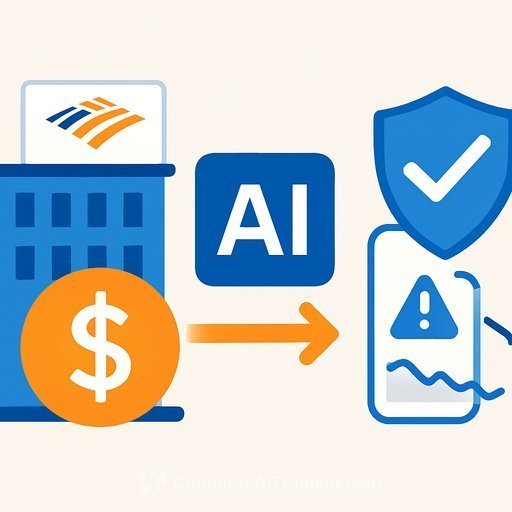
IBM: Financial Services Face AI-Scaled Attacks and Hidden Model Vulnerabilities
Europe saw a 39% surge in cyberattacks targeting finance and insurance in 2025, making it the third most-targeted region globally. The shift reflects a fundamental change in how criminals operate: they're using AI to accelerate existing attack methods rather than invent new ones.
Threat actors now generate phishing emails instantly, produce adaptive malware that evades detection, and weaponize stolen credentials at scale. IBM's threat data shows around 300,000 compromised chatbot and platform logins alone, while deepfake voice scams and AI-written fraud scripts have become routine.
But the threat cuts both ways. Banks embedding AI in their operations are discovering that the same tools they deploy for defense carry hidden risks-from biased training data to opaque decision-making that regulators cannot audit.
Banks Deploy AI to Match Attack Speed
Financial institutions are fighting fire with fire. Real-time behavioral analytics now detect unusual account activity in milliseconds, while automated threat-hunting tools scan infrastructure faster than human teams can.
Identity-based security has become central to defense. Criminals increasingly target credentials rather than trying to breach hardened perimeters, so banks are tightening access controls and monitoring login patterns continuously.
Cloud Resilience Becomes Regulatory Requirement
Banks depend on cloud infrastructure for payments, mobile apps, and trading platforms. A single outage disrupts service, frustrates customers, and creates openings for further attacks.
Regulators now require financial institutions to prove they can absorb shocks and recover quickly. Basic misconfigurations-weak identity controls, misconfigured storage buckets, unpatched systems-still cause most breaches.
Cloud resilience means ensuring the financial system functions even when unexpected failures occur behind the scenes.
AI Models Introduce Vulnerabilities at Design Stage
Training data quality matters enormously. Biased, incomplete, or poorly governed data flows directly into model behavior, producing unfair or non-compliant outcomes that scale instantly.
Complex models create another pressure point: opacity. When even developers cannot explain how a system reaches decisions, managing risk and satisfying regulators becomes difficult.
Every new AI deployment adds integrations, APIs, and data flows that expand the attack surface. Without security-by-design principles, AI projects unintentionally open new pathways into critical systems.
Traceability Enables Regulatory Compliance
In a regulated industry, banks must explain why an AI model made a specific decision. Traceability provides that record-documenting where data came from, how the model was built, what changed over time, and why outputs shifted.
When models behave unexpectedly, audit trails help teams diagnose whether the problem stems from new data, code updates, or algorithmic drift. As AI becomes embedded in critical systems, traceability ensures accountability and control.
Security Must Be Built In From Start
Banks increasingly stress-test AI models before launch and use red-teaming to uncover weaknesses under pressure. Continuous monitoring after deployment is essential because AI can drift as data changes.
Access controls, secure development practices, and model-level protections all play a role. When done properly, security-by-design does not slow innovation-it creates a safer foundation for it.
Supply Chain Remains Weak Link
Large third-party compromises have increased four-fold since 2020. Attackers exploit trust relationships and weaknesses in CI/CD pipelines, SaaS integrations, and open-source components.
AI-powered coding tools speed up development but occasionally introduce unvetted code. Banks rely on hundreds of vendors, so a single weak link can open the door to attackers.
Getting basics right internally and monitoring third-party partners closely remains essential.
Future: Security as Innovation Foundation
Security-by-design will become standard practice as AI embeds itself across fraud detection, customer interactions, and core operations. Regulation and threat velocity will drive adoption.
Humans and AI will work in partnership-automation handling monitoring and pattern-spotting while humans focus on judgment and oversight. Banks, fintechs, regulators, and technology providers will need to share threat intelligence and align on best practices.
Organizations that treat security as a foundation for innovation rather than a barrier will thrive. As AI models themselves become targets, investment in model-level security, traceability, and continuous monitoring will grow.
Learn more about AI for Finance and AI for Cybersecurity Analysts to understand how these tools apply to your role.
Your membership also unlocks: