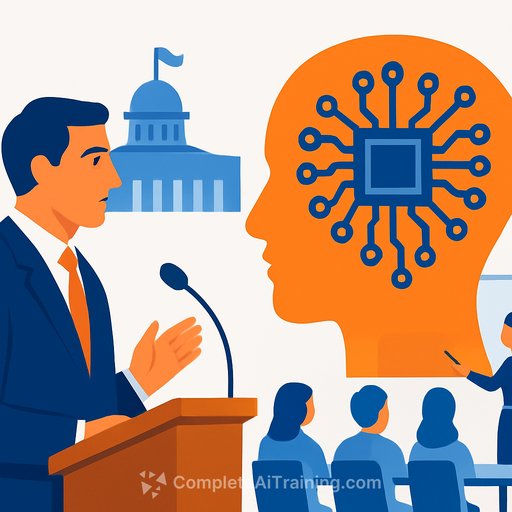
SB 1227 advances: Idaho moves to set a statewide framework for responsible AI in K-12
Idaho's Senate passed SB 1227 on Monday in a 26-8 vote, sending the bill to the House. Sen. Kevin Cook (R-Idaho Falls) is sponsoring the bill with Rep. Jeff Ehlers (R-Meridian).
The bill directs the State Department of Education, with approval from the State Board of Education, to create a statewide framework for responsible AI use in public schools. It centers on safety, transparency, accessibility, and human oversight, while requiring each district and public charter school to adopt local policies for how students and staff may use AI.
Why this matters for educators
AI is already showing up in classrooms, school offices, and the tools teachers use every day. Done right, it can personalize learning, reduce low-value workload, and help students build the skills employers expect.
"I want our kids to learn AI. I want Idaho to lead the nation in AI," Sen. Cook said, noting the state's tech strength. His message: AI is a tool that supports human judgment-not a replacement for it.
Concerns about cheating and plagiarism were raised, but Cook pointed out those issues predate AI. The opportunity is to guide use, build critical thinking, and prepare students for jobs that don't exist yet.
What SB 1227 sets in motion
- State framework: The State Department of Education will draft a statewide AI framework, with State Board of Education approval.
- Core principles: Safety, transparency, accessibility, and human oversight inform the guidance.
- Local policies: Districts and public charters must adopt clear policies for student and staff use of AI.
- Possible amendment: Cook expects the bill may be updated to explicitly state that legislators have final say on standards.
Who supports it
Kimberly Gardner of the Idaho Workforce Development Council backed the bill's "measured approach," saying employers want workers who know what AI tools are, how to use them appropriately, and when human judgment takes precedence. Idaho Education Technology Association board member William Goodman and Idaho Technology Council Chairman Reid Stephan also supported the bill, as did two members of the public. No one testified in opposition.
Organizations in support include the Idaho State Board of Education, Idaho Department of Education, Idaho School Boards Association, and the Idaho Association of School Administrators. Sen. James Ruchti of Pocatello, the chamber's eastern Idaho Democrat, voted in favor. The eight "no" votes came from Republicans.
Practical next steps for district and school leaders
- Inventory current use: Identify where AI shows up now-classrooms, admin workflows, special education, assessment tools, vendor platforms.
- Stand up a working group: Include curriculum, IT, special education, legal, teachers, students, and families to shape policy and pilots.
- Draft policy pillars: Data privacy and security; transparency and disclosure (when AI is used and by whom); human oversight for key decisions; accessibility (assistive tech and equitable access); academic integrity and assessment; bias mitigation; staff and student acceptable use; vendor requirements.
- Set procurement guardrails: Require vendors to document data flows, retention, model training use, opt-out options, and accessibility compliance.
- Plan professional learning: Short, ongoing training for teachers and staff-prompting basics, lesson planning support, feedback workflows, and guardrails.
- Pilot and evaluate: Start small with clear success metrics (learning outcomes, time saved, student engagement). Review and iterate each term.
- Communicate early: Publish guidance for families and students. Clarify acceptable use, consequences, and how AI-assisted work should be cited.
- Be realistic about detection: Set expectations-AI "detection" is unreliable. Focus on assessment design and authentic demonstrations of learning.
For context and alignment, review federal guidance from the U.S. Department of Education on AI and teaching and learning. Read the resource. You can also monitor the Idaho State Board of Education for framework updates as the bill progresses. Visit the Board.
What's next
SB 1227 has been referred to the House Education Committee. If amended and approved, districts will have clearer direction-and accountability-for responsible AI use.
If you're building capacity now, start with policy, PD, and pilots. For structured upskilling options, start with the AI Learning Path for Training & Development Managers.
Your membership also unlocks: