If AI Replaces Workers, Should It Also Pay Taxes?
AI is invisible, but it's moving markets, pulling in capital, and showing up in layoff memos. As Big Tech scales automation, governments face a simple math problem: fewer workers mean fewer payroll taxes and income taxes. If software replaces people, where does the money for pensions, healthcare, and unemployment insurance come from?
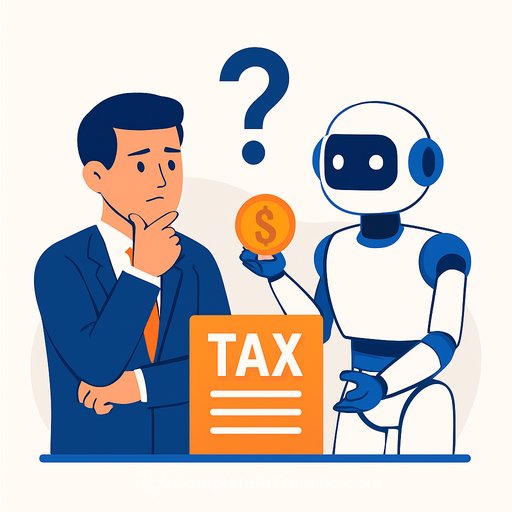
That's why an old question is back on the table: should we tax AI directly - like a "robot tax" - to plug the gap?
The core tax problem
In most countries, labor carries the fiscal load. In the U.S., roughly 85% of federal tax revenue comes from labor income. If automation cuts payrolls, the tax base shrinks and public finances feel it.
The tension: we want productivity growth, but we also need stable, predictable revenue. A narrow tax on AI could deter investment while leaving the underlying imbalance untouched.
The robot tax idea - and why it stalls
Economists and executives have floated versions of a robot tax for years. Edmund Phelps suggested taxing robots to sustain social benefits; Bill Gates argued robots should face the same tax burden as the workers they replace.
Counterpoint: drawing a clean line is nearly impossible. Is AI a chip, a humanoid, an app, or an algorithm inside existing software? If you can't define the base, you can't administer the tax. That's why many experts argue to stick with what works: tax labor, consumption, and capital - and rebalance as needed.
What institutions recommend instead
Analysts warn that an AI-specific tax could distort investment and slow productivity. A more workable route is rebalancing the mix: raise capital taxation where it has eroded, consider temporary taxes on excessive corporate profits during exceptional windfalls, and audit innovation incentives that push firms toward replacement rather than augmentation.
Another practical lever: increase capital gains taxation rather than creating a bespoke AI tax. It's simpler, broader, and harder to game.
What AI may do to growth and jobs
Forecasts pull in two directions. Some see a boost to global GDP over the next decade, with generative AI adding several tenths to annual growth. Others focus on disruption risk: one in four workers globally has some exposure to AI, especially in higher-income economies.
Most analyses land here: jobs will be transformed more than eliminated. The twist is where the impact hits - not just routine roles, but higher-skilled work that relies on analysis and content creation.
Signals from the market
We're seeing a familiar pattern: profits up, AI capex up, headcounts down. One major platform announced a 38% profit jump alongside large AI investments and thousands of job cuts.
At the same time, headline corporate tax rates in OECD countries have fallen from roughly 33% in 2000 to about 25% now. The worker tax wedge barely budged. The system rewards capital deepening over job creation, and AI takes full advantage of that spread.
Inequality and timing risks
Even if AI lifts productivity, the benefits may not reach everyone quickly. Job creation can lag behind job displacement. Lower-skilled workers face steeper reskilling curves. Gaps can widen across sectors, regions, and countries.
There's also a nontrivial energy cost to training and running large models. If that footprint climbs, it complicates any net-gain story on growth.
Policy options that work now
- Rebalance taxes toward capital: Modest increases to capital gains and corporate effective rates can offset labor-base erosion without singling out AI.
- Neutralize labor vs. automation subsidies: Review accelerated depreciation, patent boxes, and R&D credits. Favor incentives for worker-augmenting tech and verifiable job creation.
- Modernize social insurance funding: Reduce reliance on payroll taxes by shifting a small share to broader bases (consumption, capital). Keeps benefits funded even if headcount dips.
- Targeted, temporary excess-profit measures: If specific sectors see extraordinary AI-driven rents, a time-bound surcharge can fund transition programs without chilling long-term investment.
- Reskilling at scale: Co-fund training vouchers and employer credits tied to measurable skill gains in AI-augmented roles, not generic workshops.
- Wage insurance and mobility support: Short-term wage top-ups for displaced workers moving into adjacent roles, plus relocation and credentialing aid.
- Transparent measurement: Require large firms to report AI-related capex, headcount effects by function, and productivity gains. Policy is easier when the data is clean.
- Energy pricing and disclosure: Make compute energy use visible. Align rates and incentives with efficiency improvements.
What finance leaders should do
- Run tax-base scenarios: Model payroll, social contributions, and capital tax shifts across your AI adoption roadmap. Price policy risk now.
- Share the gains: Convert a slice of productivity into upskilling budgets and performance pay. It reduces resistance and speeds adoption.
- Invest in augmentation first: Tools that multiply team output often beat pure replacement on ROI and regulatory risk.
- Prepare for disclosures: Track AI impacts on roles, pay bands, and energy consumption. You'll likely need to report them.
Bottom line
A bespoke "AI tax" sounds simple, but it's hard to define, easy to sidestep, and risks dulling productivity. A better play is broad and boring: nudge the system back toward balance, fund transition tools, and make sure the incentives don't quietly favor replacement over augmentation.
Keep the option set wide, measure everything, and buy time for workers to move up the value chain. That's how you protect the tax base without kneecapping innovation.
Need practical upskilling paths?
For government and finance teams building AI-augmented roles, see targeted curricula by job function at Complete AI Training. Focus on skills that raise output within existing workflows.
Your membership also unlocks: