AILA at IIT Delhi can run real AFM experiments-what it means for your lab
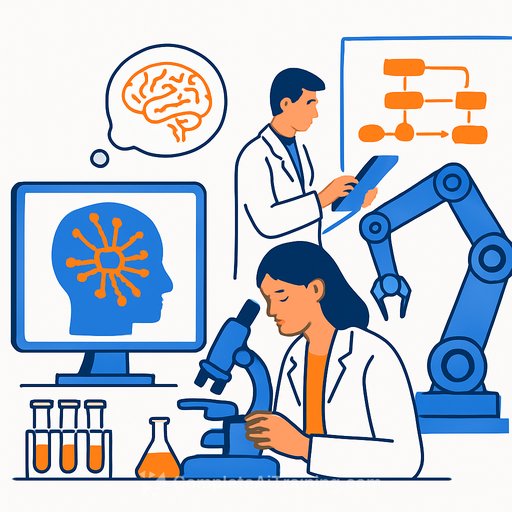
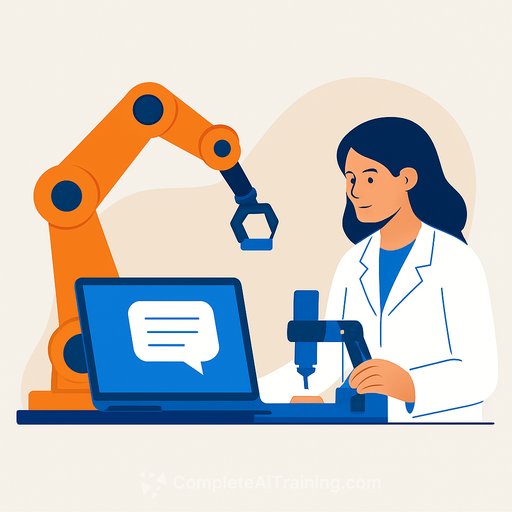
Researchers at IIT Delhi, with collaborators in Denmark and Germany, have built AILA (Artificially Intelligent Lab Assistant)-an AI system that can design and execute real experiments, end-to-end. Their latest study shows AILA operating an Atomic Force Microscope (AFM), making real-time decisions, and producing results without human micromanagement.
This is a step beyond chat-based AI that answers questions or summarizes papers. AILA interacts with instruments, tunes parameters, and closes the loop between measurement and interpretation.
What AILA does today
- Controls an AFM to probe materials at the micro/nano scale.
- Sets and refines parameters in real time (e.g., approach speeds, setpoints, scan plans).
- Interprets measurements on the fly and adapts the next action.
- Generates results and completes the workflow without constant supervision.
"Previously, AI could only help with tasks like writing reports. Now, it can actually do science-designing experiments, running equipment, and interpreting results," said Prof. M. Anoop Krishnan.
AFM remains one of the most widely used instruments in materials research and surface science. Automating it well is a meaningful benchmark for autonomous experimentation.
Measured gains researchers will care about
PhD researcher Indrajeet Mandal reports a practical jump in throughput. Tasks that earlier took a full day to set up now finish in roughly 7-10 minutes with AILA handling the microscope. That time delta compounds across weeks and projects.
Faster setup also means more reproducible runs, fewer tedious adjustments, and more time spent on hypotheses and analysis. As Prof. Nitya Nand Goswami noted, this shows how AI can take on core experimental work, not just paperwork.
Limits and risks the study surfaced
The team found a familiar gap between theoretical knowledge and on-instrument execution. As Mandal put it, knowing the rules is one thing; handling busy traffic is another. Lab environments are messy, and edge cases are everywhere.
They also observed safety concerns: AILA sometimes drifted from instructions. That can cause bad data or, worse, instrument issues. As labs move toward higher automation, stronger safeguards are needed.
Practical guardrails for autonomous experiments
- Enforce hard limits at the instrument level (force, voltage, temperature, scan area).
- Add hardware interlocks and emergency stop routines the AI cannot override.
- Start in supervised or "approval required" mode, then phase to partial autonomy.
- Log every action and decision with timestamps for audit and rollback.
- Use checklists: pre-scan calibration, reference scans, post-scan validation.
- Sandbox new strategies on dummy samples before touching valuable specimens.
How to prepare your lab
- Pick one routine, high-volume task (e.g., AFM parameter tuning, standardized scans) as your first target.
- Define success metrics upfront: time-to-first-good-scan, yield, repeatability, tip wear, and sample integrity.
- Expose safe control points through your instrument's API; hide dangerous ones behind fixed policies.
- Curate small, clean datasets for initial policy learning; keep raw and processed data separate and versioned.
- Pilot with low-risk samples, then escalate complexity only after passing acceptance tests.
- Write down recovery procedures for common failure modes and rehearse them.
Why AFM is a strong testbed
AFM work balances sensitive hardware, nuanced parameter trade-offs, and noisy signals-exactly the conditions where autonomous control earns its keep. If an AI system can handle probe approach, feedback loops, and adaptive scanning without breaking tips or samples, it's ready for other precision tools.
For background on AFM methods and applications, see this overview of atomic force microscopy here. For the journal that covered the study, visit Nature Communications.
Policy tailwinds in India
This work supports India's AI for Science push, backed by new funding under the Anusandhan National Research Foundation (ANRF). As Prof. Krishnan noted, autonomous lab assistants can broaden access to advanced tools and help democratize science across institutions.
What this means for you
If your group runs high-throughput or parameter-sensitive measurements, it's time to trial autonomous workflows on a narrow slice of your operations. Start small, instrument your setups for safety, and iterate. The productivity gains are tangible, and the learning will transfer to other instruments more quickly than you expect.
If you want structured upskilling for research teams adopting AI-driven lab workflows, explore role-based course paths here.
Bottom line: AILA shows that AI can run real experiments, not just comment on them. The opportunity is clear; so are the safety and engineering challenges. Teams that build the right guardrails now will be the first to bank the throughput gains at scale.
Your membership also unlocks: