IIT-G partners with Coventry University Group to accelerate AI in healthcare
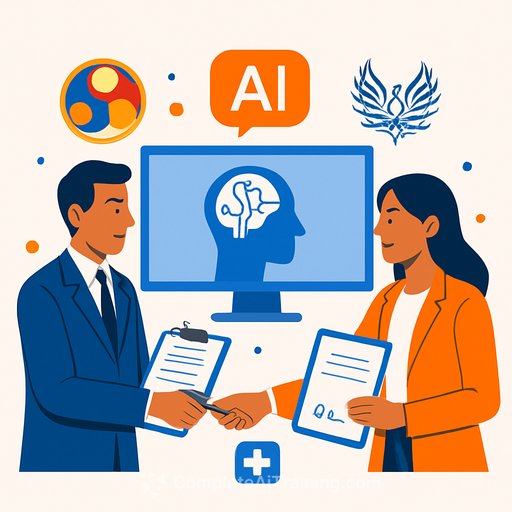
Indian Institute of Technology-Guwahati has signed an MoU with Coventry University Group, setting up a focused alliance to push AI research and training for healthcare. The partnership centers on practical collaboration: moving people, sharing expertise, and co-developing talent and tools that can work in hospitals, labs, and public health programs.
The agreement was formalised during a visit to IIT-G by CUG's senior research leadership, led by deputy vice-chancellor (research) Prof. Israel Richard Dashwood. It reflects the broader shift to technology-driven care and the need for evidence-backed AI that holds up across different populations and health systems.
What the partnership covers
- Academic and research mobility: Short-term exchanges for faculty and students to transfer methods, datasets, and real-world use cases.
- Joint doctoral programmes: A dual-award PhD under joint supervision to build cross-disciplinary talent in clinical AI and data science.
- AI for One Health: Work that connects human, animal, and environmental health, aligned with India's IndiaAI Mission.
Why this matters for healthcare professionals
Multi-institution teams can move faster on validation, generalisability, and safety-key gaps that often stall AI adoption in clinics. With Indian and UK partners, models can be tested on diverse populations and care settings, improving reliability for triage, imaging, infection control, and workflow automation.
- Clinical impact: Better decision support and earlier risk signals when tools are trained and validated across institutions.
- Public health value: Stronger surveillance and outbreak prediction using a One Health lens; see WHO's overview of One Health for context.
- Workforce development: Clearer pathways for clinicians and data scientists via exchanges and joint PhDs.
For hospitals and health systems: how to plug in
- Nominate 1-2 priority use cases (e.g., sepsis risk, AMR surveillance, imaging triage) and define success metrics upfront.
- Prepare de-identified datasets and data dictionaries; align with local regulations (e.g., India's DPDPA 2023, UK GDPR) and existing consent frameworks.
- Set up fast-track ethics review with standard templates for multi-site studies and model validation.
- Plan implementation early: integration with EHR/RIS/PACS, clinician feedback loops, and post-deployment monitoring.
For researchers and clinicians: what to expect
Watch for calls on joint supervision, short-term research visits, and pilot projects under the One Health theme. Expect emphasis on clinically grounded datasets, transparent methods, and measurable outcomes inside routine care.
If you're building skills for these projects, explore practical training in AI for Healthcare to stay current on clinical AI, safety, and health-data analytics.
The bottom line
This MoU is positioned to turn AI research into deployable tools by pairing technical depth with clinical reality. For healthcare teams, the opportunity is simple: bring a clear problem, share high-quality data responsibly, and co-create solutions that stand up in practice-not just in papers.
Your membership also unlocks: