
AI news ·
Ikea retrains call center staff as design consultants after AI chatbot Billie takes over routine queries, generating $1.3 billion in new revenue
Ikea's chatbot Billie now handles 57% of routine customer inquiries, freeing staff to retrain as remote interior design consultants. The shift generated $1.3 billion in new revenue in its first year.
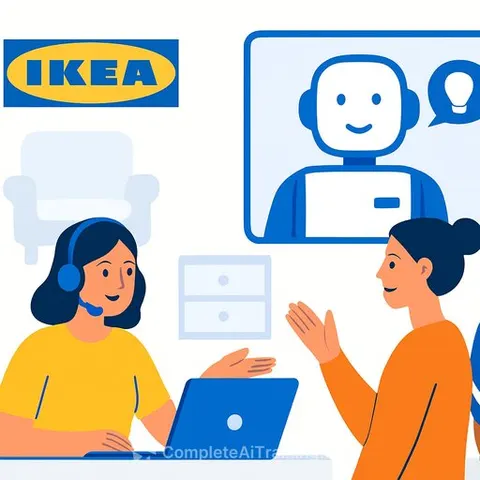
Ikea's Chatbot Freed Staff to Do Creative Work-and Generated $1.3 Billion in Revenue
Ikea built a chatbot to handle tedious customer questions, then retrained the staff it displaced into a higher-value role: remote interior design consultants. The shift generated $1.3 billion in new revenue in the first year.
The chatbot, called Billie, now manages 57% of routine inquiries-order status checks, store hours, delivery windows, product availability. These questions once consumed hours of call-center and in-store staff time each day.
Where the AI Hit Its Limits
Billie excels at transactional conversations. It struggles with everything else.
When customers asked questions like "How do I make my tiny apartment feel warm?" or "Can you help me design a living room that feels like me?"-Billie fell short. It could suggest products. It couldn't read emotion, understand personal taste, or offer the kind of advice that transforms a house into a home.
Rather than push the AI further, Ikea chose a different path. The company retrained hundreds of former customer-service specialists as remote interior design consultants.
The Human Upgrade
These consultants now offer paid virtual sessions-30 or 60 minutes-where customers work with a real person to design spaces with emotional intention. A consultant listens, asks questions, and co-creates room designs using Ikea's full catalog.
Customers who received human-guided design sessions were significantly more likely to complete larger purchases. When someone helps you imagine your future kitchen or bedroom "with soul," you don't just buy a sofa. You invest in a vision.
Conversion rates soared. The service generated approximately $1.3 billion in additional revenue in its first full year.
The Competitive Advantage
Many retailers are turning customer experience into algorithm-driven chat windows. Ikea doubled down on the opposite approach: the chatbot handles routine work, humans handle the connection.
Employees weren't automated out of existence. They were moved into more fulfilling, creative roles. Customers got the personal attention they valued. The business saw a measurable financial return.
This matters for creatives specifically. As AI design work expands, the pattern Ikea followed-using AI to eliminate drudgery, not expertise-shows where real value lives. The work that requires taste, empathy, and understanding of human need doesn't disappear when AI arrives. It becomes more valuable.
Ikea's famous mission is "to create a better everyday life for the many people." The company extended that principle to its own workforce. The result: happier employees doing creative work, more confident customers, and $1.3 billion in new revenue.