
AI news ·
Illustrated guide offers responses to "AI is inevitable" arguments in education
A Stanford review of 800+ studies found zero high-quality U.S. K-12 research measuring student outcomes without AI present. Researchers also warn of "cognitive surrender," where AI's confident outputs cause students to skip critical thinking.
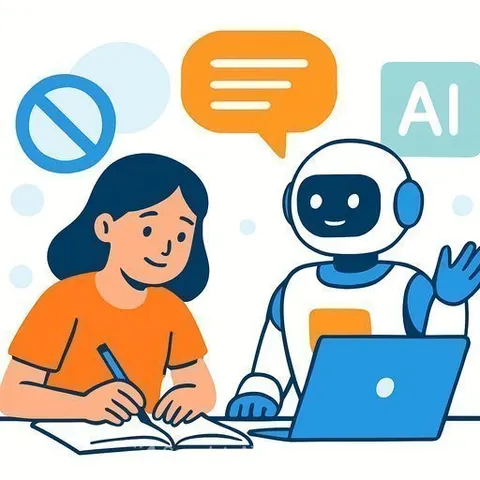
The Case Against "AI Is Inevitable" in Schools
Education leaders pushing AI adoption often rely on a single claim: the technology's inevitability. A closer look at the evidence suggests that argument crumbles quickly.
What the research actually shows
Stanford researchers reviewed over 800 academic papers on AI in K-12 education published through October 2025. They found only 20 with strong causal evidence-and zero high-quality studies in U.S. K-12 classrooms measuring student outcomes without the technology present.
The findings reveal a pattern: students show immediate gains while using AI tools for math, programming, and writing. But when tested without AI access, results become mixed. Easier tasks don't produce deeper learning.
Tools designed with guardrails-like tutoring chatbots that explain reasoning step-by-step rather than just providing answers-show more promise than general-purpose AI systems.
The cognitive surrender problem
Recent research identifies a phenomenon distinct from simply outsourcing work: cognitive surrender. When people use AI, they tend to adopt its answers as epistemically authoritative, lowering their threshold for questioning and critical evaluation.
Users shift cognitive control to the external system. AI's confident, fluent outputs feel trustworthy enough to skip deliberation. This isn't effort-saving. It's abdication of judgment.
What students and teachers actually want
Students at the University of Pennsylvania published a direct challenge to the institution's AI-first approach: "AI cannot coexist with education - it can only degrade it." They argued schools are among the few remaining places to develop independent thinking.
A survey at the University of Colorado Denver found fewer than 10 of nearly 300 respondents expressed clear support for an AI agreement. Concerns centered on environmental impact, intellectual property, and how tuition dollars would fund the initiative.
Teachers report similar skepticism. When Khan Academy's Khanmigo chatbot launched, adoption was sparse. Sal Khan, the platform's founder and a prominent AI education advocate, acknowledged the reality: "For a lot of students, it was a non-event. They just didn't use it much."
Teachers in classrooms found students weren't interested. Enthusiasm came from administrators, not educators or learners.
A broader tech backlash is already underway
Schools across North Carolina, Virginia, Maryland, and Michigan that distributed Chromebooks to every student are now reconsidering heavy technology use. Parents and educators are joining organizations like Schools Beyond Screens and the Distraction-Free Schools Policy Project to limit school tech.
One 13-year-old student noticed the difference: "Since we don't have our Chromebooks in front of our face, most people now interact with their peers and stuff."
The Alpha School case study
Alpha School, a venture-backed institution built around generative AI, provides a telling example. The school measures success by how much faster students improve on the NWEA MAP assessment compared to national averages.
Last year, using mostly the iXL platform with strong motivational incentives, students outgained the national average by 2.6x. This year, after a complete academic overhaul incorporating generative AI throughout, results stayed roughly the same: 2.5x in math, 2.8x in reading.
One hundred million dollars in funding and grand claims about AI-driven education produced no measurable improvement over a system that relied on bribing students to try harder on drill software.
Former Alpha School employees reported that constant monitoring, tracking of mouse movements, and reliance on AI tutors that sometimes provide incorrect answers with confident justifications are making students anxious.
The questions that matter
Before adopting AI, ask: What evidence supports this? Have you read recent research on cognitive surrender? Are your students and teachers actually requesting this tool?
Ask whether your school's goal is to develop independent thinking or to minimize time spent on core academics. Ask whether you're solving a real problem or adopting a solution because it exists.
The inevitability argument fails because adoption isn't automatic. It requires decisions made by people in positions of authority. Those decisions can be different.