IMF chief warns: AI will remake up to 60% of jobs-here's what managers must do now
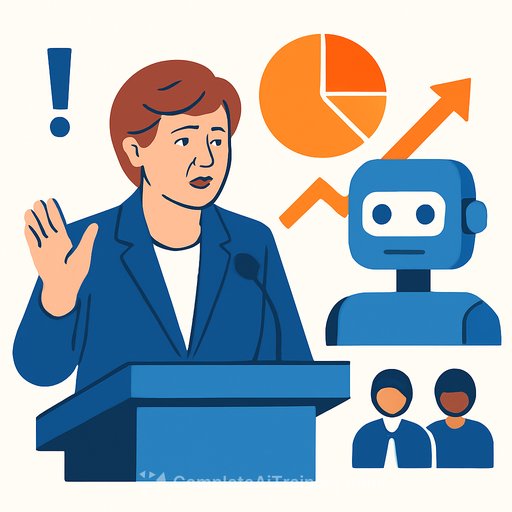
Kristalina Georgieva, Managing Director of the IMF, didn't sugarcoat it at Davos. She called AI a "tsunami" for the labor market, estimating it could transform or eliminate up to 60% of jobs in advanced economies and 40% globally.
There's a twist. While high earners gain the most from AI-driven productivity, that money spills into local services-restaurants, retail, healthcare-lifting demand for lower-wage work. She noted that one in ten jobs is already enhanced by AI, and those workers are paid more.
Key signals for leaders
- Scope of change: Up to 60% of roles in advanced economies will be reshaped; 40% worldwide.
- Premium on augmentation: AI-enhanced roles are already seeing higher pay.
- Local multiplier: In San Francisco, each new tech job was associated with ~4.4 additional local service jobs, from cooks to teachers (NBER research).
- Macro headwind: The IMF pegs global growth at 3.3%, with sovereign debt near 100% of GDP-too weak to easily fund large-scale transition (IMF debt overview).
The squeeze in the middle
The middle layer is under the most pressure. Roles that AI doesn't meaningfully improve risk flat wages. Entry-level positions-the on-ramp for young talent-are the first to be automated, creating a missing rung on the career ladder.
Georgieva called it an "accordion of opportunities": expanding for those who can plug into AI, contracting for those who can't. Your org will feel this fast-through hiring bottlenecks, wage tension, and morale drops.
Management playbook: What to do this quarter
- Run a task-level audit: For each role, label tasks as Automate, Augment, or Keep human. Prioritize high-volume, repeatable work for automation. Protect judgment-heavy work and customer moments. For frameworks and quick-win templates, see AI Productivity Courses.
- Preserve the talent pipeline: Rebuild entry-level work as "apprentice + AI" roles. Pair juniors with copilots, templates, and clear progression paths.
- Redesign incentives: Share AI gains. Introduce skill stipends, performance-based bonuses tied to AI-enabled output, and time budgets for upskilling.
- Set guardrails: Approve a short list of AI tools. Define rules for data privacy, bias checks, security, and vendor lock-in. Put a human-in-the-loop for sensitive decisions.
- Redeploy capacity: Don't just cut hours-move freed-up time to customer experience, speed-to-quote, backlog reduction, and new revenue experiments.
- Measure what matters: Track per-FTE output, cycle time, error rate, and customer NPS before/after AI pilots. Report monthly to the exec team.
- Own the narrative: Tell people what's changing, what's safe, and how they can win. Silence breeds fear; clarity builds momentum.
90-day rollout
- Days 0-30: Inventory workflows, pick 3 high-impact use cases, and pilot with small teams. Baseline the metrics.
- Days 31-60: Publish AI usage policy, choose core tools, launch training, and set up a risk review with Legal/IT.
- Days 61-90: Scale what works, retire what doesn't. Update job descriptions, compensation levers, and hiring plans to match the new task mix.
Capabilities to build across your org
- Data literacy: Clean inputs, prompt clarity, and outcome evaluation.
- Prompting and automation: From well-structured prompts to simple workflows and API handoffs.
- Process redesign: Shrink handoffs, remove approvals where risk is low, and standardize templates.
- Human-AI teaming: Escalation rules, review checklists, and accountability lines.
- AI risk basics: Bias, privacy, IP, and audit trails-see AI Research Courses for audit and bias-check frameworks.
- Vendor management: Cost controls, usage caps, and exit options.
Who gains first-and how to respond
Expect demand to climb in local services as high-earner spending rises. If you run operations in retail, hospitality, healthcare, education, or facilities, get ahead on staffing and training. Speed and reliability will win share while competitors hesitate.
Guardrails with inclusion in mind
Georgieva pressed for inclusive rules so the middle class and developing nations aren't left behind. Managers can mirror that locally: guarantee access to AI tools, make training company-wide, and publish fairness checks on promotions and pay.
Upskill your team
If you need a structured path by role, explore role-based AI learning tracks and certifications here: AI courses by job.
The takeaway
This isn't a future problem. The wave is already here. As Georgieva put it, "Wake up. AI is for real." Your edge will come from how quickly you turn AI from a cost story into a capability story-one task, one team, one metric at a time.
Your membership also unlocks: