
AI news ·
India debates technological dependence after U.S. directs Anthropic to suspend foreign access to AI models
Anthropic suspended foreign access to its newest AI models after a U.S. directive. This threatens India's $1.2 billion AI mission and exposes foreign tech reliance.
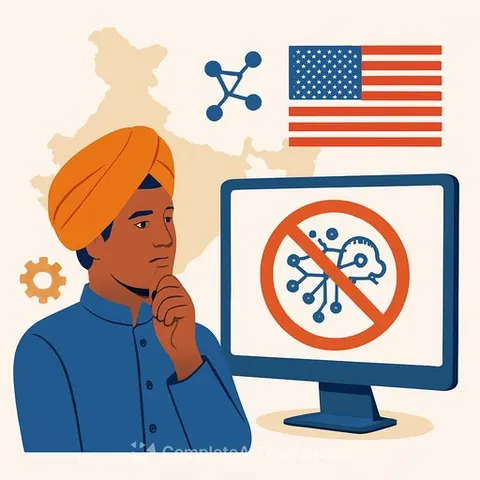
Anthropic suspended access to its newest AI models for all foreign nationals following a U.S. government directive. The move, announced late Friday, restricts access to the Fable 5 and Mythos 5 models, highlighting the operational risks of relying on foreign-controlled technology for critical infrastructure.
The directive arrived shortly after Anthropic announced a partnership with Tata Consultancy Services to increase enterprise AI adoption in India. Reports indicate Amazon CEO Andy Jassy initially raised security concerns about the models. The Information reported the White House blamed Anthropic's handling of alleged jailbreak vulnerabilities, a characterization the company disputes.
Rethinking foreign dependence
India has become the second-largest market for frontier AI companies like Anthropic and OpenAI. These firms recently increased local hiring and enterprise initiatives, betting on India's developers to accelerate adoption. The sudden access restriction has forced Indian founders and investors to reconsider this reliance.
"It completely changes things," said Aakrit Vaish, founder of Indian AI venture platform Activate. "I think this materially changes the way all of us should be thinking about sovereign AI in India." For public sector leaders, this incident underscores the urgency of evaluating AI for Government strategies that reduce dependence on foreign providers.
The push for domestic capability
Some technology leaders argue that unequal access to frontier models creates a competitive disadvantage. Vijay Rayapati, co-founder and CEO of Atomicwork, noted that his engineering team spans the U.S. and India. "If your AI team is not made up entirely of U.S. citizens, you are at a competitive disadvantage," Rayapati said.
Sridhar Vembu, founder of Zoho, called technology the "ultimate weapon" and urged Indian organizations to adopt smaller, open-source models. Investor Mohandas Pai echoed this, calling for a national mission with a $5 billion annual fund for AI and a $21 billion credit guarantee program for computing infrastructure.
India's current IndiaAI Mission allocates about $1.2 billion over five years for compute infrastructure and startups. However, the country remains a minor player in foundational model development, with most local startups building applications on top of existing foreign models.
Strategic autonomy and long-term risks
Policy experts warn that access to critical AI systems will increasingly face geopolitical friction. Prasanto Roy, a New Delhi-based technology policy expert, compared the situation to countries losing access to the SWIFT financial system after Russia's invasion of Ukraine.
"Even if this is corrected or reversed, the Anthropic episode shows there's no such thing as a geopolitically neutral foreign LLM," Roy said. "American AI models are bound to American geopolitics."
Why this matters for government professionals
Government agencies relying on foreign AI models face direct operational risks when geopolitical tensions trigger sudden access restrictions. Officials must audit current AI procurement to identify dependencies on single-vendor, foreign-controlled systems. Developing an AI Learning Path for Policy Makers can help agencies build internal expertise to evaluate open-source alternatives and establish sovereign computing infrastructure before a crisis forces the transition.